


When you put a customer's journey on one page, can someone tell which parts come from research, which are assumptions and where the experience takes a different route?
A customer journey map represents a person's experience while pursuing a particular goal. It connects activity across time and channels so a team can investigate problems and decide what to do next.
The useful result is a map that supports those decisions. A polished row of touchpoints can still hide a wait, impose one route on everyone or present a proposed improvement as something customers already experience.
This guide covers the complete mapping task, with software as a supporting choice. An original constructed renewal example shows how to preserve route differences and separate present-scenario assumptions from a future proposal; it is not customer research.
Make the journey understandable without making its uncertainty disappear.
Design task
Define the actor, goal and boundary
Start with the person whose experience the map represents. Identify the relevant responsibility and circumstances, rather than adding an invented biography to make the map feel complete.
Then state the goal and scenario. “An existing workspace administrator deciding whether to renew” establishes a different task from “A prospective buyer comparing subscription products.” Their information needs, starting points and available actions may differ.
NN/g's journey-mapping introduction identifies the actor, scenario, phases, actions and experience, and opportunities as central components. It also explains that phase names depend on the scenario. Awareness, consideration and loyalty are not mandatory columns for every map.
Write a boundary that another person can question:
- Who is the actor, and what circumstances matter?
- What is the actor trying to accomplish?
- Where does this particular journey begin and end?
- Which channels and situations are included?
- Is the map researched, assumption-based or a future proposal?
- What decision should the map help the team make?
A narrow boundary is useful when it captures a complete question. It becomes misleading when important activity is excluded simply because it happens outside the product interface.
Choose the kind of map
A current-state map represents the experience being investigated as it exists. A future-state map represents an intended experience. An assumption map can make an initial understanding visible, but its provisional status must stay explicit.
A service blueprint adds the organizational processes and dependencies supporting the experience. The IBM overview describes current-state, future-state and broader contextual variants, including the relationship to backstage work. Choose the artifact that answers the question instead of treating every lane arrangement as interchangeable.
A screen flow has another purpose: it identifies interface actions and destinations. A journey can include the email before the screen, the wait after a request and a return through another channel.
The published design-workshop guide helps structure participation and a meeting decision. A workshop may help create a map; agreement in the workshop does not establish that the map describes customers accurately.
Identify the information the map needs
Keep the fields proportional to the task. The following is a working structure, not a requirement to populate every field regardless of evidence.
| Part | Question it should answer |
|---|---|
| Actor and scenario | Whose experience is represented, under which conditions? |
| Goal and boundary | What is the person trying to achieve, from where to where? |
| Phases and actions | What meaningful activity occurs over time? |
| Touchpoints and channels | Where does contact happen, and through which medium? |
| Questions and feelings | What is supported, and what remains unknown? |
| Evidence and status | What supports the account, and what is provisional? |
| Opportunities | What needs investigation or a possible change? |
| Ownership and review | Who acts next and maintains the map? |
A touchpoint is a particular interaction; a channel is the medium through which it occurs. “Ask about renewal terms” and “support conversation” describe different aspects of the same event.
Resource kit
Begin with the method and a maintainable record
The Digital NSW mapping guidance recommends defining the user and scenario, building from research, distinguishing current and future states, and updating the map as understanding changes. It explicitly allows a journey that is not linear.
A maintained table and readable diagram can be sufficient to begin. Choose specialized software when a demonstrated requirement—such as reusable structures, selected views or linked detail—makes the existing arrangement difficult to maintain.
The three routes below are secondary tools for that work. Their public descriptions establish capabilities to investigate, not an account trial or proof that a template supplies sound research.
Smaply: maintain typed journey information
Smaply's mapping page describes stages, steps, lanes and cards for different information types. Investigate that structure when actions, channels, evidence and opportunities need a consistent home beside the same journey.

Credit: Smaply. Actual public product-page context; provider examples are not a map created or researched by Upslide.
Its plan page distinguishes a full-feature trial from continuing Free access and places some view and sharing features in paid tiers. Verify the intended maintainer, recipient and output after the trial. Do not assume that a demonstrated live link establishes the team's access configuration.
UXPressia: select views without changing the account
UXPressia's mapping page describes sections, persona views, filtering and relationships between maps. These are useful candidates when different audiences need selected detail while retaining the same underlying scenario.

Credit: UXPressia. Actual public product-page context, not an authenticated project, generated journey or completed export.
Its plan comparison separates Free PNG output from paid PDF/CSV and PPTX routes. Choose the format the recipient needs and inspect an actual received artifact during a permitted evaluation. A list of formats does not establish identical content, editability or access across them.
Custellence: retain detail behind an overview
Custellence's creation page describes rearrangeable lanes and cards. Its presentation guidance describes showing or hiding sub-lanes and connecting overview maps with more detailed maps.

Credit: Custellence. Actual public creation marketing page with its cookie notice; not an editor session, workshop or customer findings.
Consider that route when operational detail needs to remain available without dominating the customer perspective. The presentation FAQ identifies exports as a paid-plan capability. Verify the actual selected account and audience rather than inferring export permission or usability from the page illustration.
How the pieces work together
Gather material appropriate to the question
A map describing real customers needs relevant investigation. Existing interviews, contextual observations, support records and behavioral data can contribute different kinds of material, subject to the team's permissions and research requirements.
A record of an action does not explain the person's motive by itself. A recalled account does not demonstrate every detail of an interaction. Preserve the method and context when interpreting either.
Upslide's research-methods guide covers that earlier choice. The mapping task here begins with a suitable evidence plan and asks how to synthesize the resulting experience without turning interpretation into an unsupported fact.
An assumption map can help identify what the team needs to learn. Label it accordingly and leave missing evidence visible. Generated personas, AI-written stages and stakeholder guesses should not be renamed customer observations after they enter a template.
Build a timeline before compressing it into phases
List relevant episodes and their sequence before settling the high-level columns. Include entry conditions, pauses, channel changes, returns and unresolved endings where the material supports them.
Then group activity into phases that help explain the goal. A phase can contain several events; it does not need one screen or one department. Retain a way to recover the event sequence when grouping makes the page easier to scan.
Do not average incompatible routes into one apparently universal path. Compare whether they represent different circumstances, actors or meaningful variants within the same scoped scenario. Separate maps or explicitly labelled routes may be clearer than forcing an exception into an ordinary step.
Add experience information without inventing it
Questions, expectations and feelings help explain an experience when there is an appropriate basis for them. An empty template field is not an instruction to supply a plausible emotion.
Write “Unknown” when the research does not establish a claim. Keep an investigation question separate from a question the customer actually expressed. The former can guide the next study without being attributed to a person.
Use a legend that distinguishes observed or reported material, interpretation, assumption and proposed change. Review the legend with the people who will read the map; a colour that means “assumption” to its author may look like a measured severity rating to someone else.
Turn an opportunity into a next action
A map becomes useful when an unresolved issue leads somewhere. Identify the affected goal, the supporting basis, what remains uncertain and the person responsible for the next investigation or design step.
The Figma creation guide connects mapping with identifying opportunities and an action plan. That connection does not make a proposed fix validated. Keep the problem, proposed response and subsequent evaluation as separate decisions.
For example, an observed wait could prompt investigation of what information a customer needs during it. It would not, by itself, prove that a progress indicator is the best intervention or that a shorter wait is operationally possible.
When an opportunity becomes a proposed screen structure, the published free wireframe tools guide supports that next artifact. Keep the wireframe's proposed response separate from the journey evidence that motivated investigating it.
Review the map with the relevant perspectives
Walk through the scenario and inspect each important transition. Can someone explain why the person changes channel, which route skips a step and what happens while no interface action occurs?
Review the customer account with appropriate research and relevant people. Review internal responsibility with those who perform or maintain the work. Neither perspective substitutes for the other.
Upslide's healthcare journey-mapping article uses cross-app handoffs as its specific project context and labels its illustrative patient scenario. That case remains the place for that example; the general method here should not turn its proposed status response into a universal journey pattern.
Assign a maintainer and a reason to revisit the map, such as changed policy, a new channel or contradictory research. Preserve the earlier version so a reader can see which understanding supported a past decision.
Limitations and alternatives
A map does not measure the prevalence of its route
A prominent route may reflect the map's emphasis rather than how often it occurs. Do not translate the width of a column, number of cards or visibility of a problem into a population estimate.
If frequency matters to a decision, investigate it using an appropriate method and denominator. A qualitative map can explain a meaningful experience while remaining explicit that its prevalence is unknown.
A tidy sequence can hide real uncertainty
A left-to-right layout is a presentation choice. It can obscure returns, parallel activity and waiting unless those relationships remain visible.
Use descriptive route labels and a linear text alternative where helpful. Check the artifact in the format and at the size its audience will actually read. This guide does not certify an editor or map for accessibility.
A flowchart can be appropriate when the question concerns exact branching rules. A service blueprint can be appropriate when internal dependencies need their own detailed model. Keep the customer goal visible when moving into either artifact.
Mapping is a basis for investigation, not proof of improvement
No loyalty, retention, revenue or time-saving outcome follows automatically from producing a map. Those claims need their own evidence.
Likewise, a current-state map does not authorize a future feature. Keep proposed changes separately identifiable and evaluate the relevant design and operational consequences before presenting the future experience as delivered.
Worked example
Declare an original scenario and its limits
Upslide authored two fictional renewal routes for the same existing workspace-administrator role. The goal is to decide whether to renew and understand the outcome. Every event is a constructed scenario assumption; no participant accounts, quotes or emotional ratings were collected.
A maintained CSV contains ten present-scenario events and one separate future candidate. The events were written, reopened and used to build a stage-based map with actions, channels, explicit unknown feelings and opportunities linked to an owner and next investigation.
| Phase | Assisted route | Direct route |
|---|---|---|
| Orient | A1: open an email reminder | B1: open the account directly |
| Review | A2: inspect renewal details; A5: return after a reply | B2: inspect renewal details |
| Clarify | A3: contact support; A4: wait before deciding | Not included in this constructed route |
| Confirm | A6: read the outcome email | B3: confirm the choice; B4: read the receipt |
The assisted sequence is A1, A2, A3, A4, A5, A6. A5 returns to the Review phase after clarification, so the columns alone do not express the entire chronology.
The direct sequence is B1, B2, B3, B4. Its absence of support is a declared difference, not a claim that a particular proportion of customers takes that route.
Keep the future candidate outside the present-scenario map
F1 proposes an inline explanation of renewal terms. It remains a future candidate, not a feature in either present-scenario route and not a validated response to actual customer evidence.
The opportunity record asks what information might be missing when an administrator seeks clarification. A research lead owns investigation of real recent renewal episodes before a fix is chosen.
A second opportunity asks what circumstances could enable a direct decision. A product designer owns the comparison question. Neither record assumes that the routes are equally common or that adding another explanation is necessarily useful.
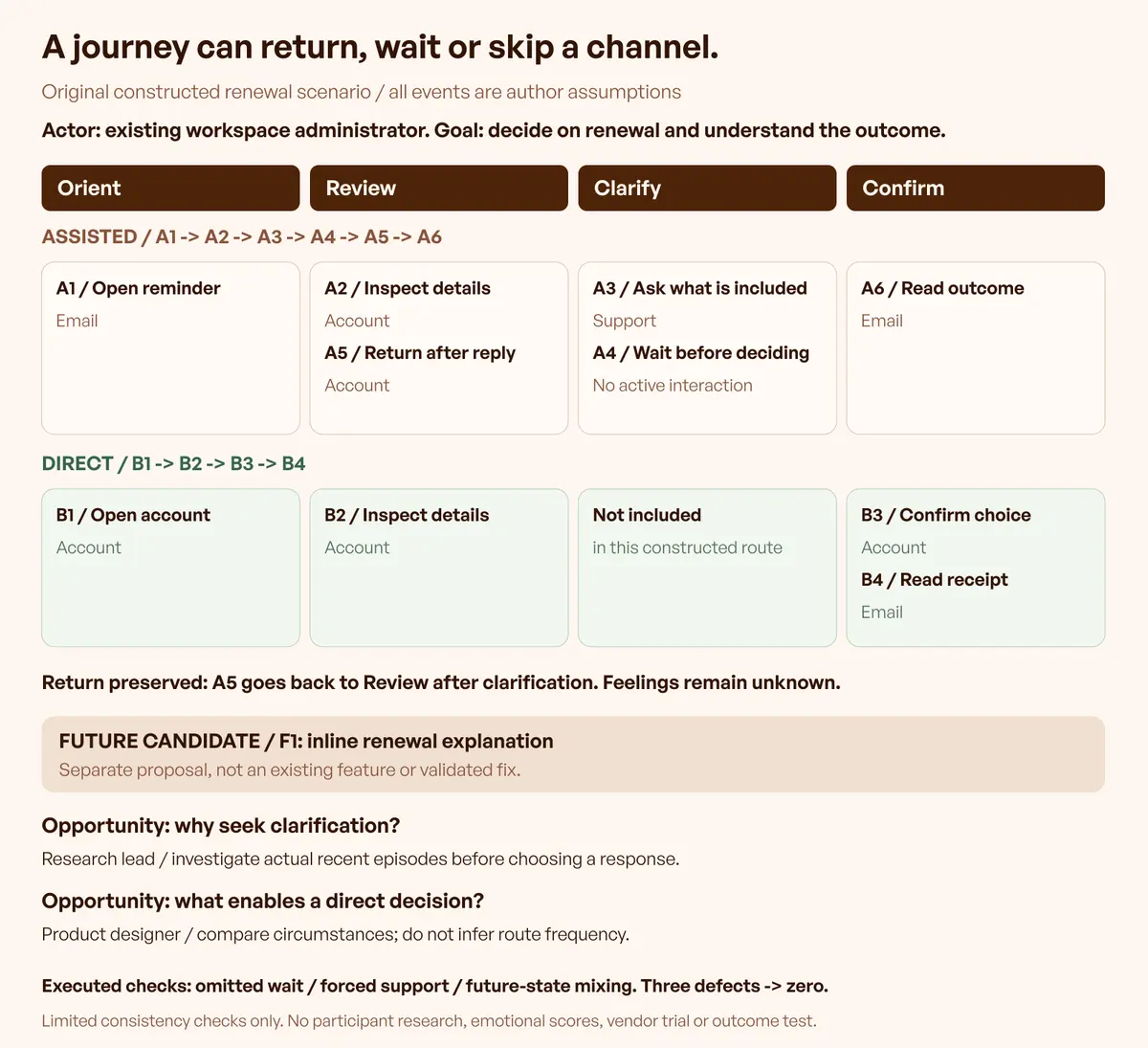
Original Upslide scenario and maintained map. All events are author assumptions and feelings remain unknown. No real customer study, vendor export or measured improvement is represented.
Inspect three declared synthesis errors
A deliberately flattened version removes A4's wait, inserts assisted-route support event A3 into the direct route, and places future proposal F1 inside the assisted present-scenario route.
The executed checker reads the actual CSV and map records. It identifies those three declared defects: omitted wait, event forced from another route and future proposal mixed into a present map. The corrected records produce zero issues under those specific checks.
The checker does not test every possible omission, duplicate or ordering error. The retained map and event list also require human review; zero issues here means consistency with these limited checks, not completeness or truth about a customer experience.
Apply the lesson to a real mapping task
Start from permitted research rather than copying the fictional routes. Compare the event sequence with the grouped map, paying attention to waits, re-entry and activity that the chosen phases might hide.
Keep unsupported feelings unknown and future proposals separate. Then identify which gap needs investigation, who owns that next step and what evidence could change the map.
Use Resource Box to choose a tool that preserves the required distinctions. Use Daily Inspire for credited presentation references; a website capture cannot supply customer evidence about why its visitors behave as they do.
Frequently asked questions
What is a customer journey map?
It represents a person's experience pursuing a specific goal across relevant activity, time and channels. Its purpose is to make that experience and the resulting questions understandable, with the evidence and assumptions clearly distinguished.
Does every map need the same five marketing stages?
Choose phases that explain the scoped scenario. A renewal, support or onboarding journey can require a different structure from a prospective buyer's journey. Preserve the underlying sequence when grouping events into phases.
Can a map be created before research?
An assumption map can make the team's initial understanding and questions visible. Label its provisional status and use it to plan investigation. Do not present its invented actions, feelings or routes as customer findings.
What is the difference between current and future state?
Current state concerns the experience being investigated as it exists. Future state describes an intended change. Keep proposed features outside the current account unless actual evidence establishes that they are already part of it.
Should every phase contain an emotional score?
Only add an emotional claim when its basis supports it. An explicit unknown is preferable to an invented curve. Keep an investigator's question separate from a feeling or question actually reported by a customer.
Is a customer journey map a service blueprint?
They are related artifacts with different emphasis. The journey follows the person's experience; a blueprint adds supporting organizational activity and dependencies. Choose the detail needed for the decision without confusing internal work with customer actions.
Which software should a small team use?
Begin with the maintainable format that preserves the scenario, evidence status and required views. Smaply, UXPressia and Custellence provide structured routes to investigate. Verify current plans, recipients and actual output before depending on a capability.
What did the original example establish?
It created a fictional map and checked three declared synthesis defects against authored event records. It did not establish real customer behavior, route frequency, vendor performance, accessibility or a successful product intervention.
Key takeaways
- Define the actor, goal, boundary and evidence status before drawing phases.
- Build from appropriate research and retain waits, returns and meaningful route differences.
- Keep unsupported experience claims unknown and proposed changes outside the current account.
- Connect opportunities to an owner and the next investigation or design decision.
- Choose software around the map that needs maintaining, then review the actual delivered artifact.
We help teams turn research and experience models into clearer product decisions. If the map reveals a wider interaction problem, discuss the design work with Upslide.


