


When you look at a comic strip without its creator beside you, can you tell which panel comes next and who is speaking?
A comic maker provides a way to combine panels, characters, dialogue and captions. The finished strip still needs an authored sequence: a situation worth showing, a meaningful change and an ending the reader can follow.
This guide compares three documented creation routes, then builds an original three-panel example with a lettering record and text transcript. It concerns the comic as the final reading experience; planning camera shots or producing a timed video requires different work.
The page must carry the story after the editor and its controls disappear.
Design task
Decide what the strip needs to communicate
Start with a sentence describing the intended reading experience. It might be a small joke, a fictional encounter or a short explanation. That purpose should guide which moments appear and how much information each panel carries.
A strip that explains something should preserve the information necessary to understand the situation. A strip that tells a joke may depend on delaying a reveal. The same panel arrangement does not automatically serve both purposes.
The author can draft three elements before selecting software:
- The situation at the beginning.
- The change or discovery that moves the story forward.
- The ending, including anything deliberately left unresolved.
This is a starting structure for a small exercise, not a rule that every comic must contain three panels or resolve every question. Longer stories and experimental layouts need their own treatment.
Distinguish the final comic from its preparation
A comic can be planned with a rough script and thumbnails. Those artifacts help the creator make decisions, but the final reader normally sees the strip itself rather than the private production notes.
An editor can show panel numbers, layers and selected objects that disappear in the exported image. The author therefore needs to inspect the delivered page to determine whether its order, lettering and visible relationships remain clear.
A storyboard serves another purpose when it describes proposed shots, movement or audio for a production team. The published AI video guide addresses generated footage; a completed comic page does not need to become a film to fulfil its own brief.
Write the dialogue before final illustration
Dialogue occupies space. A character placed across the entire panel can leave nowhere for a balloon, while a long explanation may force lettering below a useful reading size.
Prepare a small script with panel identifiers, visible action, speaker names and exact words. Revise the wording and composition together, rather than treating lettering as an element to squeeze into leftover space.
The script also reveals different kinds of text. Spoken words belong to a character; a caption may establish a location or time; a sound effect represents something happening in the scene. The final design should make those roles distinguishable.
Resource kit
Canva, Adobe Express and Storyboard That provide documented comic creation routes. They are listed in the Resource Box, with task-specific source references and verification limits.
| Route | Published creation approach | Question for the intended project |
|---|---|---|
| Canva | Comic templates, grids, uploaded artwork and speech bubbles | Can the selected layout accommodate the script and final reading size? |
| Adobe Express | A comic creation route illustrated with an editing and sharing sequence | What controls and asset conditions are available in the actual workflow? |
| Storyboard That | Scenes, characters, panel layouts, dialogue and captions | Which edition and output preserve the intended content and permissions? |
This comparison uses public documentation and actual attributed provider artwork. No featured account, paid subscription, export process or reader test was operated for the article. Current entitlement and selected asset terms need checking before adoption.
Canva: compose the strip around panels and lettering
Canva’s comic strip maker page documents templates, grids, uploaded sketches and speech bubbles. Those components provide a starting arrangement, which the author can assess against the actual script.

The provider preview shows a four-panel workplace-themed design beside template choices. It is actual published interface artwork, not a comic made in an Upslide account or proof that a template’s content suits another project.
Canva’s educational comic article discusses restrained dialogue, readable text and interpretable expressions. Those are useful composition questions; its broad claims about learning and attention are not treated here as measured outcomes.
An author using a template should replace placeholder content deliberately. A frame that worked for a short label may not fit a two-person conversation, and changing the words can alter the reading path even when the illustration stays the same.
Adobe Express: inspect the proposed creation route
Adobe Express’s comic communication article describes choosing a layout, scenes and characters, then adding dialogue. Its communication examples are suggestions from the provider, rather than evidence that a comic improves understanding in every context.

The published artwork shows a workplace comic and a dialogue-editing overlay. The illustration establishes its source and depicted concept; it does not verify current controls in a particular account or establish a successful training result.
A prospective user should inspect how words, characters and panel arrangements can actually be revised in the intended route. A convincing promotional example cannot answer whether the editor permits the exact correction a project needs.
The same distinction applies to generated artwork. If generation forms part of the selected workflow, inspect character continuity, text and factual content in the output. A generated image should not inherit the accuracy or permissions of an unrelated reference.
Storyboard That: assemble scenes and dialogue
Storyboard That’s comic maker page documents panel layouts, scenes, characters, speech bubbles and additional text. Its full comic-strip tutorial also describes reviewing the strip and preparing a receiving output.

This provider example uses animals and picture-based bubbles across several panels. Its source is a small published image; enlarging it does not create additional detail, so it should be treated as an attributed overview rather than a readable production file.
A scene-based editor offers a different starting point from uploading finished illustrations. The author should investigate character poses, balloon placement and whether the required layout and delivery route belong to the selected edition.
The public pages contain trial and edition messaging. This guide does not convert those messages into a promise that all assets, exports or commercial uses are free. Verify the actual selected plan and content conditions before distributing the result.
How the pieces work together
Establish the reading path
For the original example, panels run left to right in a single row. That is a declared arrangement for this strip, rather than an assertion about all comics or reading cultures.
Within each panel, the first balloon should lead naturally to the next relevant visual or piece of dialogue. An author can inspect whether a large decorative element competes with the opening line, or whether a balloon appears to point at the wrong speaker.
Panel identifiers are helpful during revision, but the reader should not need to decode a private numbering system to follow the story. If an unusual order is intentional, the design needs to communicate that intention.
Preserve character and object continuity
A repeated character needs enough visible consistency to remain identifiable. Clothing, placement, silhouette or a name can contribute, while changes should have a narrative reason.
Important objects also need continuity. If a later panel depends on a map being upside down, the drawing or accompanying text needs to establish that condition. A decorative rectangle with no orientation cue can leave the intended change unclear.
Continuity does not mean every panel must be identical. A useful change of framing can reveal information or emphasise a reaction, provided the reader can still connect the scene to what came before.
Give lettering enough room
Balloon placement and text size are composition decisions. The words need space, the speaker relationship needs to remain visible and the sequence of speech should agree with the intended conversation.
When a panel becomes crowded, inspect the script before shrinking everything. The author may be able to remove repeated explanation, split a moment or move contextual information into a caption.
The receiving format matters. A strip that is readable on a large editing canvas may become difficult to read in a small social image. Check the actual intended placement and provide a readable text version where it helps the audience.
Keep the editable source and a text record
Retain the source layout, original assets and the exact dialogue alongside the delivered file. This makes corrections possible without relying on text recovered from a flattened image.
A transcript should include the information needed to follow the story, not only the spoken words. If a joke depends on a changed object or expression, that visual event belongs in the accompanying description.
A transcript is useful supporting content, but its presence alone is not an accessibility audit. The delivery context, available alternatives and actual reader experience still need examination.
Worked example
Define a small fictional story
“The library map” is an original fictional strip with two characters, Ari and Sol. Ari asks where to find a shelf, studies a map in the wrong orientation, then recognises the problem after it is rotated.
The example uses simple original vector figures and schematic map marks. It is not adapted from a provider template, and no featured editor was used to produce it.
| Panel | Visible situation | Dialogue in reading order |
|---|---|---|
| P1 | Ari and Sol stand beside a library map. | Ari: “Which shelf?” Sol: “Try the map.” |
| P2 | Ari studies the map upside down. | Ari: “This looks strange.” |
| P3 | The map is shown in its intended orientation. | Ari: “Now that makes sense.” |
The illustration uses a downward orientation marker in the first two panels and an upward marker in the third. Labels make the schematic change explicit. The sequence does not show a detailed physical performance or claim that a reader has understood the joke.
Keep the balloons attached to their speakers
The lettering record gives every balloon a stable identifier. P1 contains B1 from Ari followed by B2 from Sol; P2 contains B3 from Ari; P3 contains B4 from Ari.
Those labels let the author discuss wording and order separately from the placement of the drawings. If B2 moves, its record should still identify Sol as the speaker rather than silently becoming Ari’s line.
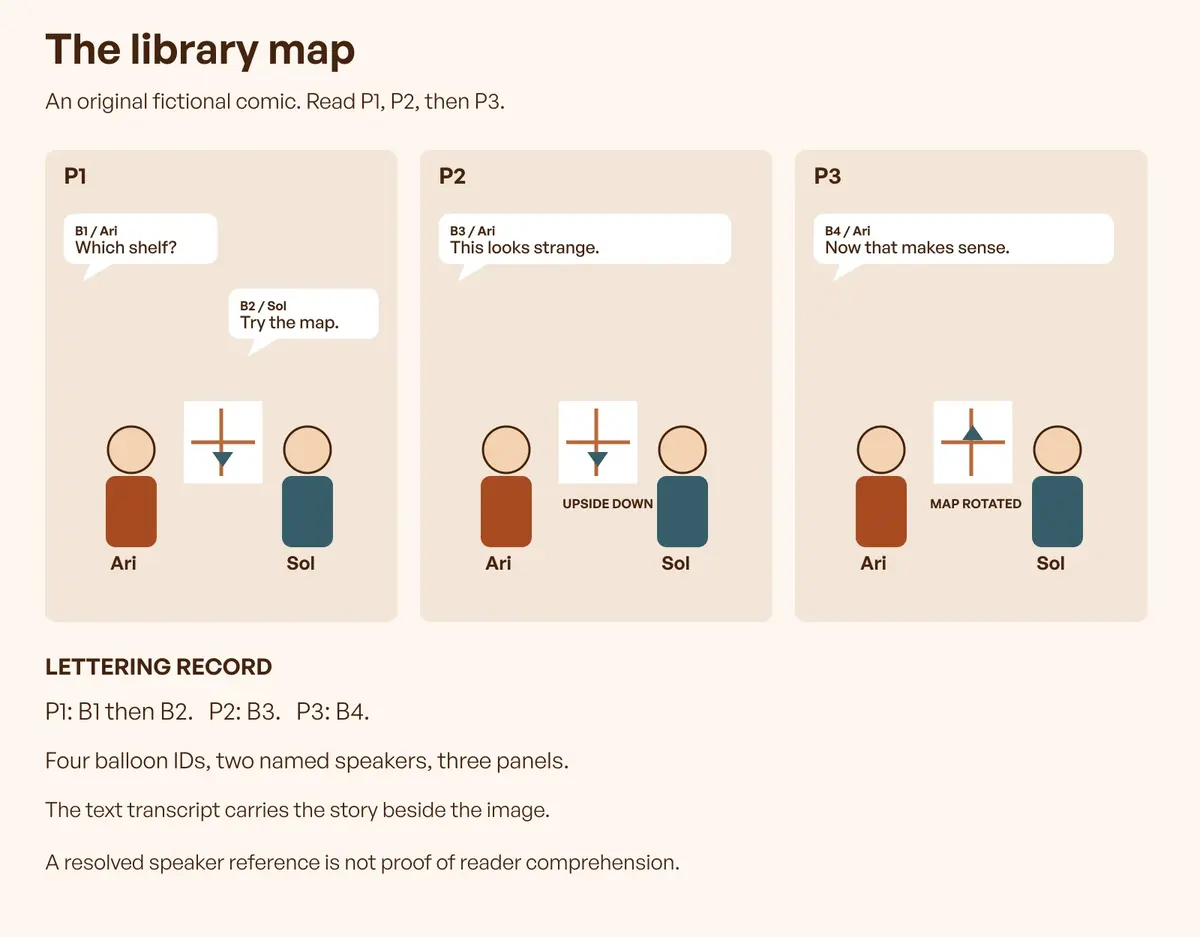
The wide graphic includes the strip and its lettering record. The adjacent HTML table and text carry its exact dialogue and visual premise when the image is displayed too small to read comfortably.
Check the saved record and an invalid variation
The source was saved and reopened as a structured local file. Its record contains three panels, four unique balloon identifiers, two named characters and a reading order that refers to the stored panels.
A structural check confirmed that the balloon speakers resolve to the two declared characters. A deliberately invalid copy changed B3’s speaker to “Unknown”; the check identified that unresolved name.
This result concerns consistency of the authored record. It does not establish artistic quality, a good joke, reader comprehension or correct behaviour in any featured software. No audience observations were collected.
Review what the final page needs
The map’s orientation change is central to the example. Without that visible or described change, the final line loses its intended context even if every balloon identifier is valid.
A useful next review would ask a reader to describe what happened without an explanation from the author. The team could then inspect where the intended story and the reader’s account differ. That review is proposed, not reported as completed here.
The same principle applies to lettering. A valid speaker reference in the source does not prove that the balloon tail points clearly at the right person in the final image. The record and the rendered page need complementary checks.
Limitations and alternatives
A comic maker can provide layout and illustration components, but it cannot decide whether a scene communicates the intended idea. An author still needs to inspect wording, sequence, continuity and the delivered reading experience.
A prose explanation may suit information that needs frequent updates or extensive detail. A slide sequence can support a presenter, while a storyboard can describe proposed production shots. These artifacts overlap in visual techniques without having identical purposes.
For visual composition in other formats, the published visual hierarchy guide addresses emphasis and reading order. Use Daily Inspire to examine attributed layouts in context, without inferring private production methods from their appearance.
This article’s provider material is promotional or instructional artwork with explicit attribution. It supplies no account benchmark, export verification, learning outcome or guarantee of commercial permission.
Frequently asked questions
What does a comic maker help create?
It helps assemble panels, pictures, words and captions into a comic. The available starting point may be a template, a scene library or imported artwork. The author still needs to decide how the finished strip communicates its story.
How many panels should a strip contain?
Use enough panels to show the changes the story requires. The original example uses three as a small teaching choice. A fixed number cannot establish whether another story has enough context, space for dialogue or a satisfying ending.
Can a comic be made without drawing every character?
Some documented routes provide templates, scenes or character assets, while others accept uploaded artwork. Check the selected assets and their conditions. Using supplied illustration does not remove the need to compose the page or verify permission for the intended use.
Is a comic the same as a storyboard?
A comic is the reading artifact in this guide. A storyboard can be a plan for shots, movement and audio in another production. Both use panels, but the information needed by their recipients and the meaning of completion can differ.
How should dialogue order be checked?
Record the intended speakers and balloon sequence, then inspect the rendered page. The visible reading path and balloon relationships should agree with the script. A correct text record alone does not prove that the final placement is clear.
Should an AI-generated comic be accepted without revision?
The output still needs review for text, character continuity, important objects and any factual claims. The required permission and account conditions also need checking. This article does not claim that generation guarantees a complete or accurate strip.
Were the featured tools tested with the library example?
No. The example uses original local vector artwork and a saved lettering record. Public provider documentation and attributed examples were reviewed, but no featured account, plan, export workflow or reader study was executed for the article.
What should accompany the final strip?
Retain the editable layout, asset sources, current dialogue and a version label. A readable transcript can preserve the words and relevant visual events. Inspect the actual receiving format rather than assume the editor view represents the audience’s experience.
Key takeaways
- Define the intended situation, change and ending before polishing panels.
- Compose lettering with the artwork and keep speakers distinguishable.
- Preserve continuity in characters and important objects.
- Inspect the delivered reading size and retain a useful transcript.
- Treat structural checks, visual review and reader observations as different evidence.
We help product teams make information clearer through design. Explore the free Upslide UI/UX course for structured practice with hierarchy, composition and communication.


