What do you need to learn from a user interview before the conversation can change a product decision?
A useful interview starts with an uncertainty about someone's experience. It creates space for an account that may challenge the team's explanation, including an account in which the supposed problem did not occur. The moderator's job is to understand that experience without supplying the preferred answer.
This guide follows the method from research question and recruitment through preparation, moderation, interpretation and a bounded next decision. An original guide-construction exercise shows two revisions and two fictional scenario descriptions. Its executed checks concern declared guide structure and follow-up selection; no participant interviews or research findings are represented.
A complete conversation can still leave an important question unanswered. Preserve that uncertainty rather than completing the story for the speaker.
Design task
Decide whether an interview can answer the question
Interviews help explore people's circumstances, priorities, recollections and explanations. Nielsen Norman Group's introduction distinguishes those reported accounts from behavior observed in a usability test. The distinction matters even when both activities happen on the same video call.
An interview about a recent room change might reveal how a coordinator describes involving colleagues. It cannot, by itself, establish that every attendee received the change or that a particular interface caused a delay. Those claims need suitable additional evidence.
| Open question | Useful interview direction | Further evidence that may be needed |
|---|---|---|
| How was responsibility for contacting attendees decided? | A recent incident and the person's explanation | Other involved roles or permitted operational records |
| Can someone find a room-change control? | An account can provide context | Observation of a realistic interface task |
| How common are missed updates? | Accounts can reveal situations worth investigating | Reliable definitions and appropriate aggregate evidence |
| Would a notification feature solve the problem? | Explore the underlying circumstances first | Evaluation of an actual proposal and its operational assumptions |
The research question should leave room for several explanations. Starting with a proposed feature can turn the conversation into a sales discussion before the team understands the work.
Define the experience that makes a participant relevant
For a room-coordination study, a job title is insufficient. A facilities manager who approves budgets may have a different account from someone who personally redirects arrivals. Define relevant experience, its recency and the roles needed to understand the decision.
Include meaningful variation when it affects the question: a recurring meeting versus a one-off event, an onsite coordinator versus a remote organizer, or an incident that went smoothly versus one with an unresolved consequence. Those are recruitment considerations, not a claim that every possible group must appear in one small study.
Stakeholders can explain constraints and policy, while users can describe their own experience. Neither should silently stand in for the other. A colleague's convenient availability also does not make that colleague representative of the intended audience.
Plan recruitment around the study's scope and uncertainty. There is no universal interview count that establishes coverage or saturation for every question, and a small purposive group does not yield a population percentage.
Establish the session arrangements
Clarify who moderates, who takes notes and whether anyone observes separately. Explain the purpose and intended use of the material through the study's approved participant arrangements. Observation and recording require their own explanation; an observer hidden from the call grid still hears the conversation.
Ask about practical access needs when arranging participation. The location, communication format, interpreter or support arrangement can affect whether a person can take part comfortably. A universal rule against sharing information in advance may conflict with a participant's needs; preparation should support participation while avoiding unnecessary priming.
Select recording only when appropriate and approved. Notes can be useful without audio, and an additional recording copy creates another handling responsibility. Do not promise anonymity, confidentiality or deletion capabilities that the selected process cannot actually provide.
Resource kit
Lyssna: inspect the meeting and capture arrangement separately
Lyssna's interview guidance describes meeting integrations and an assistant that can support recording or an observer room. The documentation says the assistant can be present without recording when automatic recording is off.

Credit: Lyssna. Actual public help-page capture from 2 November 2026, reused as source context. No interview, account configuration or recording by Upslide is shown.
That distinction is relevant to the session brief, but the bot's presence is insufficient evidence of active capture. Inspect the selected configuration and its retained result during an appropriate rehearsal.
The current help page still contains inconsistent manual-upload access wording: an earlier passage calls the route paid-only, while another describes an external recording and upload for Free users. This guide leaves that entitlement unresolved and does not promise free uploads. The relevant workspace, storage and output conditions need confirmation before the study depends on them.
Discuss: examine the observation workflow
Discuss's human-led research page documents an observer suite, participant waiting room and controls for capturing moments during live sessions. Those are relevant capabilities when colleagues need a separate observation route.

Credit: Discuss and its credited creators. Actual public-page capture from 2 November 2026, reused here. Provider imagery is not an Upslide participant session.
The operational question is how observation fits the moderator's work. Set expectations about when questions reach the moderator so internal discussion does not direct every follow-up or interrupt an important account.
Availability of an observer feature does not establish the selected account's access, the suitability of its sharing arrangement or an improvement in research quality. The researcher still owns the discussion guide and interpretation. No purchase, live session or output test was performed for this guide.
UXArmy: keep human-led and automated methods explicit
UXArmy's DeepDive page presents human-led interviews, hidden observation, internal chat and timestamped notes. It also presents an AI Moderator route separately.

Credit: UXArmy and displayed creators. Actual public-page capture from 2 November 2026, reused as an attributed reference. No demonstration or participant recording was operated by Upslide.
The distinction is methodological as well as operational. A researcher deciding when to probe an unexpected account is not the same setup as an automated conversation. Choose that arrangement deliberately rather than treating a shared product name as evidence that moderation is equivalent.
Current product wording includes free and paid routes with account and credit conditions. This guide does not infer unlimited recorded sessions, universal AI access or a comparable price from a free-entry label. Verify the intended human-led route and required collaboration conditions before adopting it.
These three resources are operational options, not a requirement to replace an adequate existing setup. Their public descriptions were checked on 4 November 2026. None supplies an interview question, participant fit or research finding automatically.
How the pieces work together
Turn the research question into a flexible guide
GOV.UK's in-depth interview guidance connects research questions with ordered topics, starter questions, possible follow-ups and a pilot. The guide preserves the topics worth covering without prescribing every turn of the conversation.
Begin with context that helps the participant describe the relevant work. Move toward a specific recent event where possible, then explore actions, other people, available information and consequences. An event anchor can support detail without guaranteeing accurate or complete recall.
Separate a research question from the question spoken aloud. A team may want to understand coordination ownership; asking “How is coordination ownership managed?” may introduce unfamiliar language. A more ordinary prompt can invite the account before the researcher asks who became involved and how their responsibilities were decided.
Keep future-feature reactions distinct from accounts of actual experience. A person predicting that they would use a notification is providing a prediction, not evidence that the proposed feature would reach the right people or resolve the underlying situation.
For choosing a starting document, the published UX research templates guide distinguishes study plans, interview guides and task scripts. It covers document selection; the conversation still needs questions and follow-ups suited to the research uncertainty.
Pilot before interpreting the conversation
A pilot can reveal unclear wording, a topic order that feels abrupt or a session setup that consumes the available time. Record the guide revision and what the pilot actually changed. A colleague can help examine wording and logistics while still being unsuitable evidence about the target users' experience.
Check the conversation route and capture arrangement separately. A functioning meeting link does not prove that a note-taker can recover the material later. If recording is part of the approved plan, rehearse its relevant controls and inspect an allowed sample output.
The construction exercise below is not such a human pilot. It checks stored guide files and scripted branches only. A passing program cannot establish that the wording works in conversation.
Listen before selecting the next probe
Start with the agreed introduction and space for questions about participation. During the discussion, allow the person to finish an account before introducing the next topic. A pause can be useful; it does not always need to be filled with another question.
Follow the detail supplied rather than forcing an expected sequence. If a coordinator mentions delegating a phone call, ask about that responsibility.
If the account concerns directing arrivals onsite, investigate what information was available there. The guide is a support for listening, not a branch script that overrides a different real account.
Use clarification when a term has several meanings. “The room change was complete” might refer to changing a booking, notifying one colleague or redirecting everyone. Ask what the person means before converting the phrase into a completed operational outcome.
Review the account without supplying its missing explanation
After a session, distinguish the person's exact words, a paraphrase and the researcher's interpretation. Check a relevant passage against the approved original material when available. A transcript can omit or misattribute a phrase; an automated summary can make an uncertain account sound settled.
Compare accounts in context. Similar wording can describe different circumstances, while a contrasting account may challenge the proposed explanation. Record what was not asked or not established instead of treating silence as evidence that something never happened.
Interpretations should remain inspectable. “The coordinator described asking a colleague to call attendees” supports a narrower statement than “Delegation caused missed updates.” The latter introduces both an outcome and a causal explanation that may require further evidence.
The main UX research methods guide helps select that additional method. Interview accounts can shape the next investigation without establishing task success, prevalence or a product improvement by themselves.
Limitations and alternatives
Keep recall, observation and prediction distinct
Recall can be incomplete, and the way a question is asked can influence the account. Someone may describe what usually happens rather than what occurred in the requested incident. Follow up on that distinction without treating the participant as an unreliable adversary.
When a claim concerns an interface action, suitable observation may be more useful than further questioning. When it concerns reach across many cases, appropriately defined aggregate records may be necessary. When roles disagree about responsibility, another relevant perspective may be needed.
An interview can be combined with other activities, but name the transition and retain the evidence type. Asking someone to perform a prototype task after an interview adds an observation activity; it does not turn every earlier recollection into directly observed behavior.
Close with the uncertainty and the next decision
Allow room for clarification and anything important the participant wants to add. Explain the next steps that the study can actually support, then thank the person. Avoid promising that a requested feature will be built.
For the team, retain the research question, guide revision, relevant context, actual evidence and unresolved alternatives. A useful outcome may be a better follow-up question or a decision to investigate another role, rather than an immediate interface change.
Worked example
Revise an original guide before using it with people
The fictional exercise concerns facilities coordinators handling a recent last-minute room change. The open decision is what needs investigation before proposing a coordination feature. No participants were recruited, and no statements below are participant quotations.
| Topic | Authored first revision | Authored second revision |
|---|---|---|
| Recent event | How frustrating was the room-change software? | Think of the most recent room change you coordinated at short notice. What happened? |
| Coordination | Did you call everyone and update the booking, and would automatic notifications solve this? | What did you do next? |
| Unresolved detail | So a notification feature would have prevented the problem? | What, if anything, remained unresolved at that point? |
The first starter presupposes software and frustration. The revised starter permits a manual process or an account in which the change went smoothly. The second original prompt bundles several activities with a proposed feature; the revision invites a next action before exploring its detail.
The final revision leaves room for nothing unresolved. These are editorial reasons for changing the wording, not a claim that the revised prompts have been validated as neutral or effective with people.
Rehearse two declared branches without inventing interviews
Two authored scenario cards provide different inputs. One describes a fictional coordinator phoning a colleague expected to contact attendees, without specifying how responsibility was agreed. The other describes a coordinator redirecting arrivals near the original room, without specifying the information available there.
The stored guide declares a different follow-up for each. The phone card selects “How was it decided who would contact the people involved?” The onsite card selects “What information was available to the person directing arrivals?”
The Python builder writes and reopens the guide files, scenario cards and rehearsal CSV. Its actual replay selects the two declared follow-up identifiers. This establishes the scripted relationship in the saved construction, not how an interview would unfold.
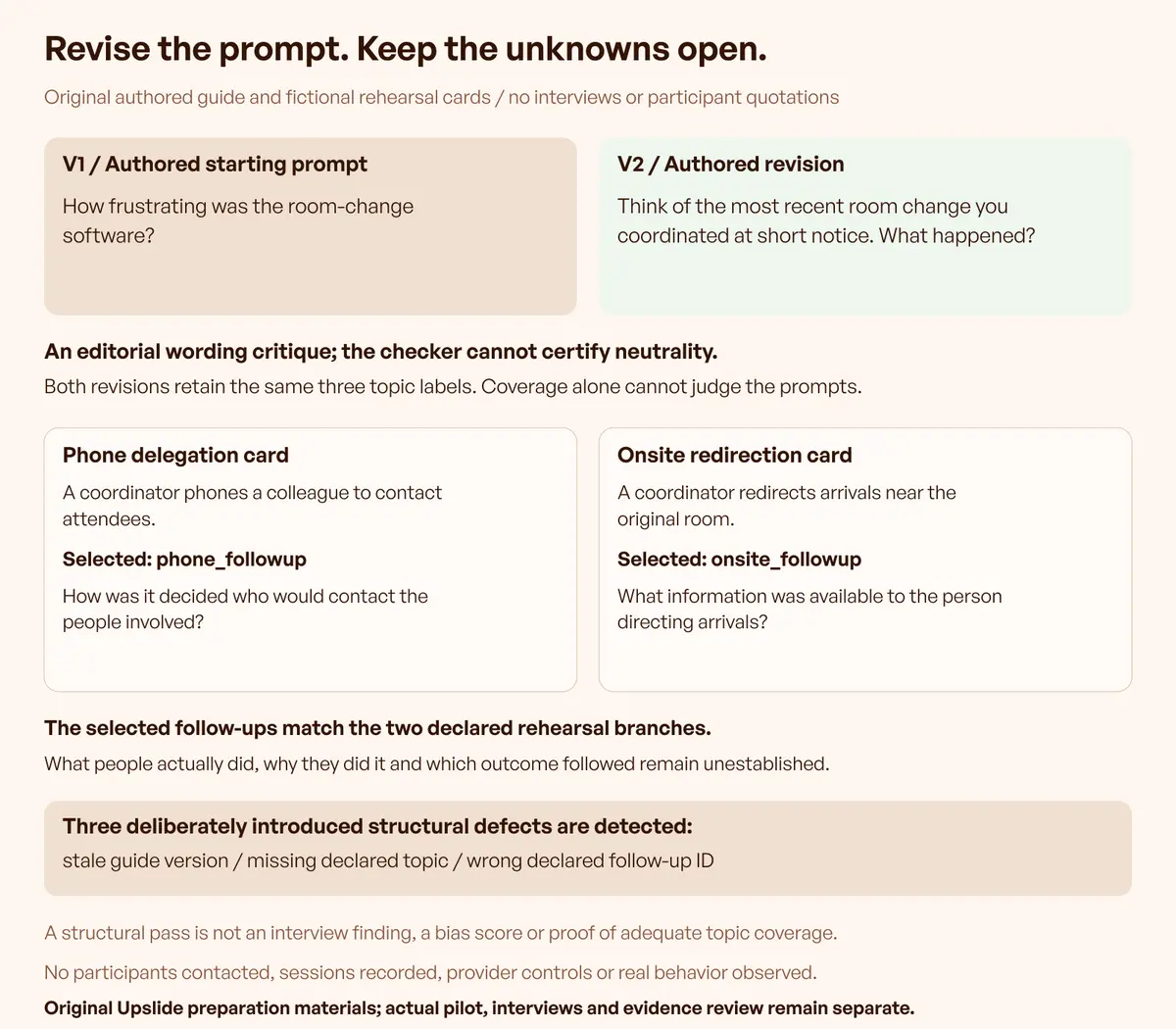
Original Upslide construction. Fictional scenario descriptions, not participant quotes. Executed JSON/CSV checks cover declared branches, versions and topic labels; they do not validate interview quality or produce research findings.
Inspect what the checker can and cannot detect
The baseline has no declared structural errors. Three deliberately altered inputs then produce the expected errors: a stale guide version in the CSV, a missing required topic and the wrong follow-up identifier for the phone branch.
Both guide revisions contain the same three topic labels. A coverage check alone therefore cannot distinguish the leading first wording from the revised wording. The program does not judge whether a question is neutral, whether the relevant topics are sufficient or whether a person understands a prompt.
The unanswered details also remain unanswered after replay. Neither card establishes whether every attendee was reached, why the route was selected or whether a product change would help. The retained editorial critique and structural results support preparation for further investigation; they justify no notification feature or finding about coordinators.
Frequently asked questions
What is a user interview?
A user interview is a research conversation about a person's experience, context or perspective. The moderator asks relevant questions, listens and follows up. Its reported accounts differ from behavior directly observed in an interface task.
How should interview questions be prepared?
Begin with the research uncertainty, then identify topics, starter prompts and possible follow-ups. Review presuppositions and bundled questions, pilot the guide appropriately and retain revisions. A topic checklist cannot certify the quality of the wording.
How many people should be interviewed?
Choose participation around the scope, relevant variation and evidence needed. There is no universal count that establishes saturation or supports a population percentage. Repeated accounts still need contextual interpretation, including attention to contrasting cases.
Must every interview be recorded?
Choose capture around the approved study arrangements and participants' choices. Recording may support later review, while notes can serve another setup. Verify what is captured and retained rather than assuming a meeting bot or screen-sharing state answers that question.
Can a stakeholder replace a user participant?
Stakeholders can explain organizational goals and constraints. Their account does not automatically represent the experience of someone doing the relevant work. Recruit for the experience the question needs and retain the distinction between those perspectives.
Should an interviewer follow the guide exactly?
Use it to preserve important topics while following the actual account. Clarify unfamiliar terms and probe relevant details without inserting the expected answer. Unexpected circumstances may require a question absent from the prepared guide.
Does the original exercise establish better interview results?
No. It demonstrates authored prompt revisions and executed structural checks on fictional materials.
No participant conversation, question-quality test or research finding occurred. The next appropriate evaluation still requires people and suitable study conditions.
What should the team retain after analysis?
Keep the question, guide revision, contextual evidence, interpretations, contradictions and unresolved limits under the approved handling arrangements. Record the next decision separately from a participant's requested solution or an analyst's hypothesis.
Key takeaways
- Choose an interview around an uncertainty about experience.
- Recruit for relevant work and prepare a flexible guide.
- Listen and clarify before supplying an explanation.
- Keep reported accounts, observations and interpretations distinct.
- Retain unanswered questions alongside the next decision.
Use Resource Box for current official destinations and Daily Inspire for attributed visual material when a discussion needs it. A visual prompt is context for a question, not evidence about the creator's private workflow.
We help teams connect research questions with product decisions through Upslide's design services. Start with one uncertainty that a conversation can meaningfully investigate.