


Can someone understand your business from the pitch deck without mistaking a planned pilot for customer adoption? A polished presentation can still leave that question unanswered. The problem often starts before layout: the story mixes what the team observed, what it believes and what it intends to do next.
A useful pitch deck explains the business through a connected argument. The audience should understand the customer problem, the proposed solution, the opportunity, the business model, the team's progress and the next step. Evidence should support that argument without making uncertain claims look settled.
This guide builds that structure and compares practical roles for Pitch, Canva and DocSend. An original fictional claim register demonstrates a small consistency check, including a deliberately incorrect metric label. It is teaching material, not a real startup's traction, market validation or fundraising result.
The strength of the story depends on keeping the meaning of its evidence intact.
Design task
Define the business and the conversation
Start with a plain explanation of what the company does, for whom and in which situation. A phrase such as “the future of connected work” may sound ambitious while leaving the reader unable to identify the actual product.
Name the conversation the deck supports. An initial introduction, a detailed follow-up and an internal business review require different levels of explanation. The same underlying company story can support them, with the content adapted to what the audience already knows.
Also decide whether the deck will be presented live or read independently. A spoken explanation can connect sparse slides during a meeting. A sent file must carry enough context for a reader who cannot ask what an unexplained diagram means.
Separate the company story from the reusable template
A template supplies layout roles, styles and reusable objects. It doesn't establish that the business has a clear problem, a credible solution or measured progress. Complete those content decisions before treating a sample deck's headings as a list of facts to fill in.
The existing presentation-template article covers making reusable layouts from brand and interface assets. This guide concerns the argument inside a particular business pitch: what each section needs to explain and how its statements connect to supporting material.
Keep an editable content outline beside the slides. If the story cannot be followed as short headings and supporting sentences, decorative charts are unlikely to repair it.
Resource kit
Compare the jobs around the deck
| Resource | Relevant role | What still needs review |
|---|---|---|
| Pitch | Create and revise a presentation in a slide workspace | Generated or template content, source accuracy and the receiving format |
| Canva | Compose a deck using presentation layouts and visual assets | Selected assets, reading conditions and actual export behaviour |
| DocSend | Share a document through controlled links and inspect viewing activity | Audience permissions, the selected plan and interpretation of analytics |
These roles can be complementary. A sharing tool isn't the source of the business argument, and an editor doesn't verify a claim because it placed it in an attractive layout. No common export or sharing benchmark was run for this comparison.
Pitch: bring a reviewed outline into authoring
Pitch's current creation guide describes prompting its agent with context and choosing a template. It lists supported contextual inputs including documents, structured files and images.
Supply material the team is authorized to use and has already checked. Then review the resulting wording, examples and images against that material. The availability of a generation feature doesn't establish that the generated deck preserves every qualification or avoids introducing unsupported statements.

Credit: Pitch and the template's creators. Actual artwork from Pitch's 9 November 2022 article, retrieved and inspected on 16 November 2026. It illustrates a template's prompts, not an Upslide-authored deck or an outcome from using it.
Canva: replace the example content before judging the layout
Canva's pitch-deck guide presents templates and describes collaborative editing and PDF delivery. Those provide starting and review routes; the selected features and account conditions still need checking.
Replace example charts, names and screenshots with representative content early. A layout that works with a short sample heading may fail when the actual claim needs a qualification or source note. Keep those qualifications visible instead of shrinking them into a decorative footer.

Credit: Canva. Actual published promotional artwork, retrieved and inspected on 16 November 2026; original capture date unverified. This is provider imagery, not an Upslide account operation, exported deck or user study.
DocSend: keep distribution and interpretation separate
DocSend's official site describes document sharing, access controls and viewing analytics. It is relevant when a team needs a deliberate distribution route after preparing the content.
Confirm who should receive the material and what the chosen account permits before sharing it. Viewing activity can inform a follow-up question; it doesn't establish that a recipient understood a claim, agreed with it or made an investment decision.

Credit: DocSend and the depicted creators. Actual artwork from its 25 November 2019 pre-meeting-deck article, retrieved on 16 November 2026. This historical example isn't a current-interface guarantee or analytics collected for this guide.
How the pieces work together
Build a connected business explanation
Sequoia's business-plan guide provides a compact set of business questions, including purpose, problem, solution, opportunity, alternatives, business model and team. Use such prompts to examine the story, rather than as proof that one order or slide count works for every company.
The following content map is a working outline. A topic can need more than one slide, while related points can sometimes be combined without losing clarity.
| Part of the explanation | Question the reader needs answered | Material to prepare |
|---|---|---|
| Company and customer | What does the company do, and for whom? | A concrete description and initial customer context |
| Problem | What is difficult today? | Current workflow and relevant supporting observations |
| Solution and product | How would the product address that difficulty? | A focused explanation, demonstration or labelled proposal |
| Opportunity and timing | Why examine this opportunity now? | Defined segment, dated sources and explicit assumptions |
| Alternatives | What could the customer do instead? | Real alternatives, including current workarounds |
| Business model | How does the proposed business operate? | Customer, payer and proposed commercial mechanism |
| Progress | What has actually happened so far? | Defined measures, period, source and limitations |
| Team and next step | Who will execute, and what happens next? | Relevant responsibilities, open questions and a clear request |
The map should expose gaps. If the team cannot support a proposed claim, mark the question as unresolved or change the statement. Don't invent traction because a borrowed template contains a growth chart.
Connect the problem to the product demonstration
Describe the difficulty in the customer's work before showing a list of capabilities. Then select the product material that explains the proposed improvement. A detailed tour of every screen can obscure the relationship the audience needs to understand.
Use an actual product capture when the claim concerns an available capability. Label a prototype or concept as such, even when its interface looks finished. A rendered proposal should not silently become evidence that the feature has shipped.
DocSend's pre-meeting guide discusses explaining the problem, the team and the product for readers without a presenter. Its historical viewing statistics are not treated here as a current attention limit or a guaranteed prescription.
Give market and business-model statements their own support
Define the customer segment before presenting a large category number. Retain the source date, geography and definition of any externally reported figure. Explain which part is observed information and which part depends on the team's assumptions.
A proposed pricing model should be described as proposed when it hasn't been tested. A customer interview, a sign-up, a trial and a paying account are different records. They can each inform the story without being interchangeable evidence of revenue.
Likewise, distinguish the user from the buyer when they are different people. That distinction affects the explanation of the business, even before the deck contains detailed commercial forecasts.
Make progress understandable without overstating it
Every metric needs a defined subject, period and source. “Active” should mean something the team can explain, and a chart should retain the information needed to interpret its change.
If there is no measured adoption yet, show the actual state of the work and the next question to investigate. A planned pilot is a plan. A completed prototype is evidence of a prototype, not evidence that customers rely on it in production.
Pitch's structure article distinguishes live and independently read versions of a deck. Carry necessary context into each version, rather than assuming a qualification mentioned aloud will travel with an exported file.
Worked example
Create a fictional claim register
Consider a fictional product called Queueleaf, intended to help a team coordinate handoffs. The name, business, sources and numbers below are invented for this exercise. No interviews, customers or investment outcomes are represented as real.
The local register contains eight claims across problem, solution, product, progress, market, business model, team and next step. Three are labelled observations, three hypotheses and two plans. This is a compact teaching set, not a recommended eight-slide limit.
The fictional source records contain four interviews, two prototype tasks and two founders with assigned responsibilities. Those records deliberately support narrow statements. They don't establish demand, product adoption or the founders' ability to execute a real company.
Retain the connection between statement and record
The problem statement cites the fictional interview record and preserves its metric: interviews. The product statement cites the prototype-task record. The team statement cites the declared founder count.
The solution, initial segment and subscription approach remain hypotheses. A pilot and a later validation activity remain plans. Their labels keep the example's uncertainty visible while allowing the proposed business to be explained.
The register and source files were saved, reopened and checked locally. The check verifies that declared observations have a source and that their metric names and values agree with that source. It doesn't assess whether the sources are truthful, representative or sufficient.
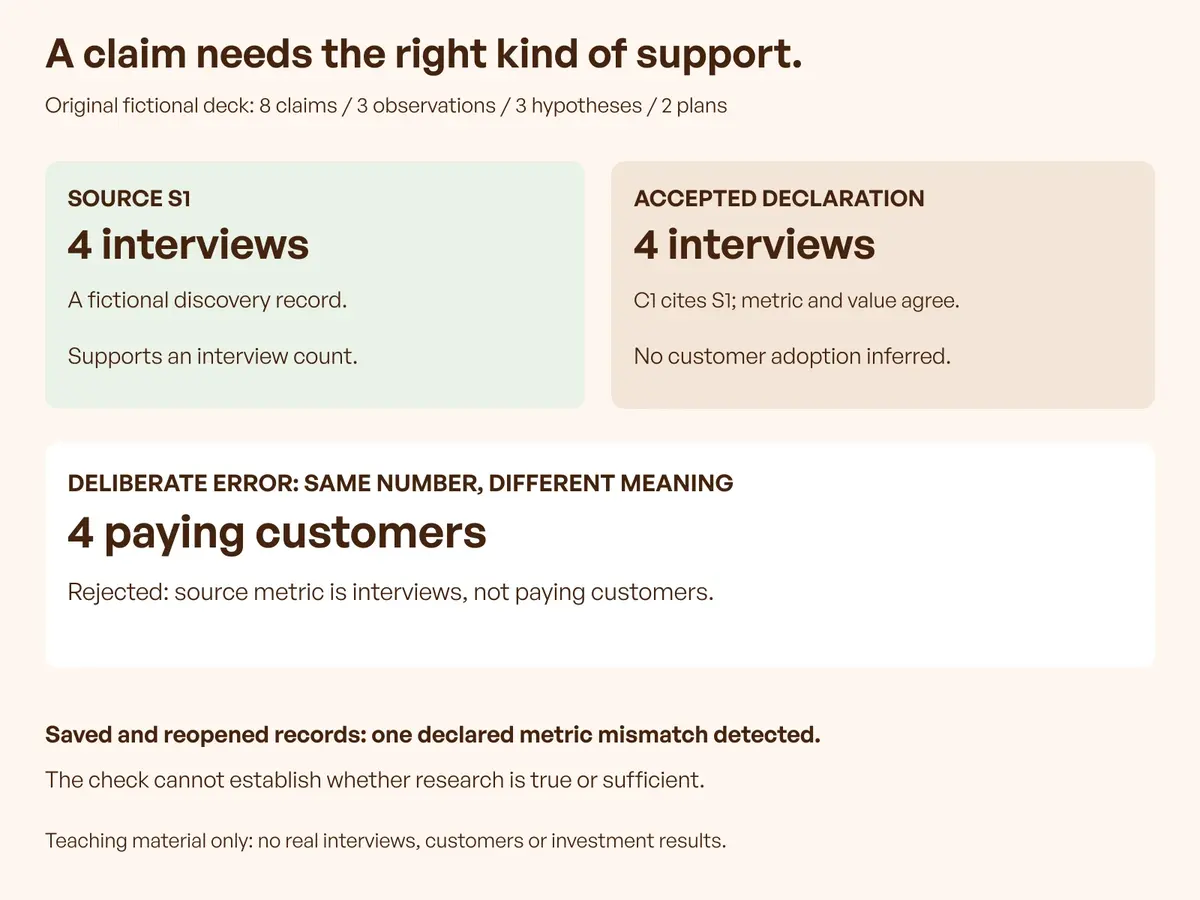
Original exercise: Upslide Design Studio. Eight fictional claims and three declared source records were saved and reopened. The deliberately changed metric is detected; no real customer evidence, semantic fact-checking system or fundraising result is implied.
Introduce an error with the same number
The deliberate negative version changes the first observation from four interviews to four paying customers. The number stays four and the source identifier stays the same. The declared metric changes, so the local check rejects the mismatch.
This demonstrates a specific failure that a number-only check would miss. Copying the correct value doesn't preserve its meaning when the unit or subject changes. In a real deck, the reviewer should compare the whole claim with the underlying record.
The check is intentionally limited. If someone altered the headline while leaving its declared metadata untouched, this simple predicate would not understand the contradiction. Human review of the actual slide wording remains necessary.
Review the story after the consistency check
Passing the mechanical check doesn't make Queueleaf a credible business. The initial customer segment is still a hypothesis, the commercial mechanism is untested and the pilot has not occurred. Those are substantive questions for the fictional team to investigate.
The next draft should make that state clear. The deck can explain the proposed problem and solution while recording what evidence is missing. It should not use a polished chart to turn an unresolved question into an apparent result.
This is the useful output of the exercise: a coherent narrative accompanied by a record of what each important statement means and what supports it. The file can then be reviewed for clarity, relevance and missing work.
Limitations and alternatives
Keep the slide and its source note connected
A source list at the end helps with retrieval, but an important qualification often belongs beside the claim. A reader should not need to guess which chart a date or population definition applies to.
If the note becomes unreadable, change the composition or divide the explanation. Reducing the text size until the slide resembles the sample template protects the appearance at the expense of the argument.
Keep historical results and scenarios distinct
A historical measure describes a defined past period. A projection depends on assumptions. They can appear in the same business discussion, but should not share an unexplained visual treatment that makes them look equally observed.
Retain the assumptions and ownership of any scenario outside the slides as well. The deck should summarize a reviewed model rather than become the only place where the calculation exists. This guide does not calculate a financing requirement or recommend investment terms.
Inspect the version that will actually be sent
Reopen the exported file or intended sharing destination. Check titles, charts, source notes, images and links in the receiving environment. A correct authoring view doesn't establish that fonts, wrapping and annotations survived the handoff.
Also check who can access the material. Remove sample or confidential content that should not travel with the deck, and retain the version associated with the review. Updating the source is insufficient if a stale export remains the file being circulated.
Ask reviewers to explain what they understood
Invite a colleague to describe the customer, problem, proposed solution and actual progress after reading the deck. Ask which statements they interpreted as measured and which they understood as plans.
Record misunderstandings and revise the relevant language or composition. This proposed reading check isn't an investor study, and a positive response doesn't predict a fundraising outcome. Its purpose is to make the presentation easier to interpret correctly.
Continue in Resource Box and Inspire
Use Resource Box to reach the original authoring and sharing tools, then check the selected route's current conditions. The directory supports finding a workflow; it doesn't certify the claims inside a deck.
Use Daily Inspire to study visual hierarchy and product explanation on attributed original sites. Translate useful communication principles to the slides rather than copying a homepage into the deck.
The browser-mockup guide addresses keeping interface material readable in presentations. Keep the business-model questions and supporting assumptions in the content outline while the deck is revised.
Frequently asked questions
What is a pitch deck supposed to explain?
It should connect the company, customer problem, solution, opportunity, business model, progress, team and next step. The emphasis depends on the conversation. A sequence of attractive slides is useful only when the audience can follow that explanation.
How many slides should it contain?
Use the space required to communicate the relevant business clearly, within the actual reading or presentation conditions. A sample structure is a starting point rather than a universal limit. The eight claims in the exercise aren't an eight-slide rule.
Can an early-stage deck include untested ideas?
It can explain hypotheses and plans while labelling them accurately. Keep them separate from observations, measured adoption and historical revenue. The audience needs to understand both the proposed direction and the work still required to support it.
Is a customer interview evidence of a paying customer?
No. It is evidence of an interview within its actual context. Preserve the meaning of the source record and describe payments or adoption only when the relevant records support those statements.
Can an AI-generated deck be used as the final version?
Review the actual output against the authorized source material, including numbers, wording, images and qualifications. Generation can help assemble a draft; it doesn't verify the business or establish that every statement is supported.
Should the live and sent versions be identical?
They can share the same underlying facts while differing in explanatory detail. A sent deck needs enough context without narration. Keep qualifications intact across both versions and check the actual exported or shared material.
Do document analytics show whether the pitch succeeded?
Viewing activity alone doesn't establish comprehension, agreement or a decision. Use the available signals to frame a follow-up, with the limitations of the selected tool and settings recorded. This guide reports no recipient analytics.
What does the original consistency check prove?
Only that the declared references, metric identities and values agree in the fictional saved records, and that a known mismatch is detected. It cannot establish the truth or adequacy of research, interpret every headline or approve the business argument.
Key takeaways
- Build a connected explanation of the business before polishing layouts.
- Distinguish observations, hypotheses and plans throughout the story.
- Preserve each metric's meaning, period and source.
- Review actual slide wording as well as structured claim records.
- Inspect the final delivery and keep the reviewed version identifiable.
We help SaaS teams turn complex product stories into clear visual communication. If the product explanation needs design support, discuss it with Upslide.


