
Which free font website should a designer trust when the typeface will appear in a real product, client website or paid campaign?
The useful answer is not simply the website with the largest catalogue. A source helps a team discover and obtain a font, but the font's own licence decides what the team may do with it. Commercial artwork, website embedding, app distribution, editable templates and redistribution are different uses. A “free download” label does not automatically answer all of them.
This guide reviews six font sources already listed in the Upslide Inspire Resource Box: Google Fonts, Fontshare, Font Squirrel, The League of Moveable Type, Velvetyne and Collletttivo. Their public previews were inspected on November 2, 2026. The guide compares what each source helps a designer discover, where licence certainty still has to come from, and how to turn a visual preference into a documented SaaS typography shortlist.
The order is not a ranking. Every project should preserve the exact licence file or terms page that applies to the selected family.
Design task
Start with the intended use, not a style adjective
“We need a modern font” is too vague to guide a safe choice. The design task becomes clearer when the team names the surfaces, language needs, delivery method and people who will handle the files.
For a small SaaS product, the same type family might appear in a marketing website, web application, sales deck, exported PDF and social artwork. Those outputs create different practical questions:
- Can the font be used in commercial graphics and client work?
- Can webfont files be self-hosted or served through an approved provider?
- May the font be embedded in an application, PDF or editable template?
- Can a contractor receive the files, and must they delete them later?
- Does the family include the scripts, symbols, numerals and weights the interface needs?
- If the font is modified, are there naming or redistribution conditions?
Write a one-sentence brief before browsing: “Choose a heading and body family for an English-language B2B SaaS website and web app, with clear numerals, at least four usable weights, commercial artwork permission and a documented web-embedding route.”
That sentence separates three decisions that are often blurred together: visual fit, functional coverage and legal permission. A beautiful specimen solves only the first.
Save evidence with the design decision
A licence check should leave a recoverable record. Save the source URL, font family name, version or download date, licence name, licence file and the specific use that was checked. If the source points to a third-party foundry, preserve the foundry's terms rather than treating the directory description as the final authority.
This is not legal advice. It is a practical design-operations habit that makes later review possible. When the intended use is unusual, commercially important or unclear, the team should ask the rights holder or qualified counsel.
Resource collection
Compare the six sources at a glance
| Source | Useful starting point | Licence signal observed | Limitation to carry into the project |
|---|---|---|---|
| Google Fonts | Broad open-source discovery, language filters and web use | Google describes the directory as open-source fonts | Preserve the selected family's licence and test language coverage |
| Fontshare | Curated families and pairings from Indian Type Foundry and other publishers | Fontshare states its collection is free for personal and commercial use | Confirm the family page, scripts, weights and delivery route |
| Font Squirrel | Commercial-use-oriented discovery and use icons | Its FAQ says it tries to verify commercial desktop use | It explicitly asks users to read each font licence, especially for embedding |
| The League of Moveable Type | A small open-source foundry collection | The League states its catalogue uses the SIL Open Font License | Read reserved-name, attribution and modification conditions for the family |
| Velvetyne | Experimental libre type and distinctive display choices | The public source presents an independent open-type collection | Review the exact family licence and test legibility before interface use |
| Collletttivo | Collaborative open-source typefaces | The public source identifies an open-source type foundry and network | Treat each family's files and terms as the final record |
The matrix is deliberately task-based. A directory can be strong for discovery without being the final source of permission. A foundry can have a clear catalogue-wide position while a specific family still deserves its own saved licence evidence.
1. Google Fonts — broad discovery with family-level checks
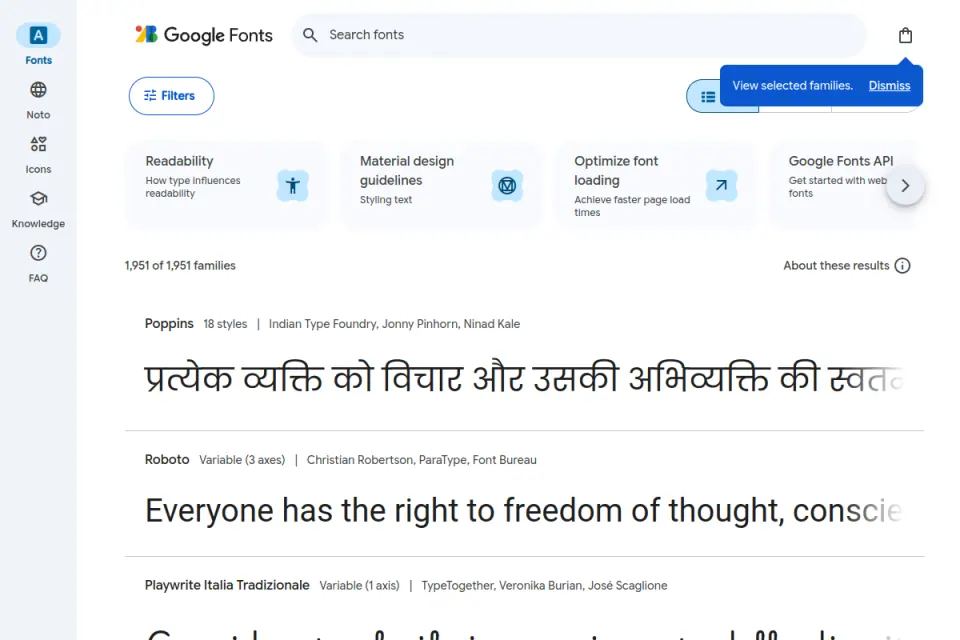
Google Fonts presents an extensive open-source directory with search, filters, language information and specimens. Its own licensing guidance describes the catalogue as open source. That makes it a practical first stop when a team wants a transparent starting point for website typography.
The visual review also shows why the directory is useful beyond downloading files: a designer can compare families against multilingual sample text and inspect available styles. For the SaaS brief, search for families that include the required scripts, then test product words, numbers, punctuation and dense labels rather than judging only the default specimen.
Open source does not remove the need to retain the selected licence. Families can use licences such as the SIL Open Font License, and conditions around reserved names or modified versions still matter. Save the family page, the licence file distributed with the font and the chosen files.
- Useful when: The team wants a broad, filterable open-source starting point and a clear web-oriented workflow.
- Check next: Family licence, supported scripts, variable/static files, weight range and rendering in the actual interface.
- Do not assume: Every family will provide the same character coverage or make a good body-text choice.
2. Fontshare — curated families and pairings
Fontshare's About page says the service was launched by Indian Type Foundry and offers its collection free for personal and commercial use. It also describes a mix of ITF families and reviewed open-source releases from other publishers.
The collection is useful when a team wants a smaller, more directed browsing experience than a very large directory. Pairing suggestions can help a designer move from “one attractive heading face” to a more complete hierarchy.
The preview currently stored in Inspire is a minimal brand view rather than a complete catalogue capture. It proves the source identity, not the available families or their current features. Open the live family page, verify scripts and styles, and save the terms that apply to the selected family.
- Useful when: A curated collection and ready-made pairing ideas will shorten exploration.
- Check next: The family page, available files, language coverage and the current licence text.
- Do not assume: A suggested pairing automatically meets interface readability or performance needs.
3. Font Squirrel — useful licence cues with an explicit warning
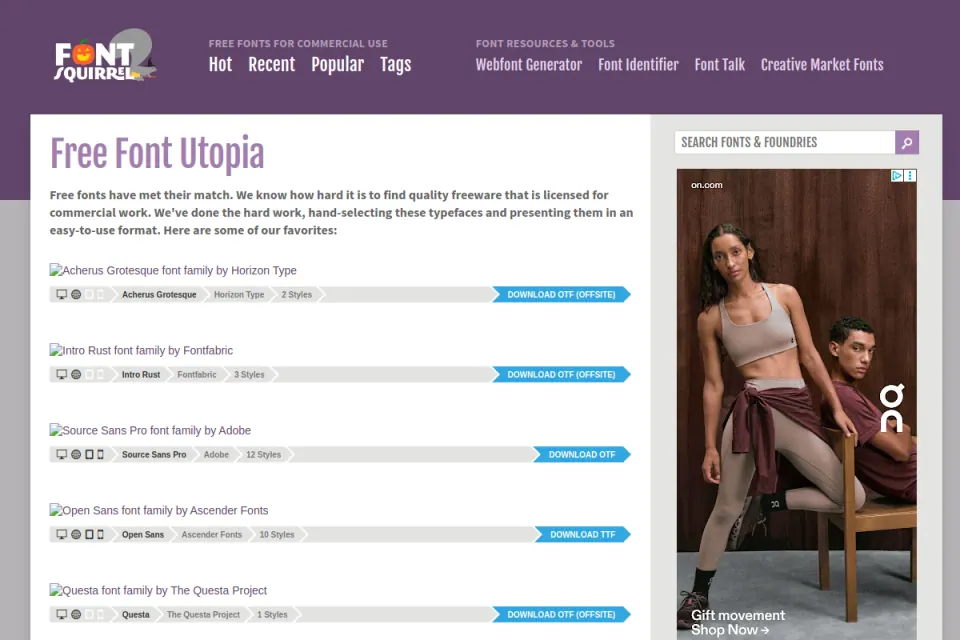
Font Squirrel's FAQ explains that the site tries to verify free commercial desktop licences, but it repeatedly tells users to read each font's licence. It also distinguishes desktop use from web, ebook/PDF and application embedding through separate indicators.
That distinction is the source's most useful lesson. A team selecting a font for website graphics may have a different answer from a team distributing the file in an app. The directory's indicator can guide discovery, but the family licence remains the evidence.
The public preview includes catalogue rows and advertising. It should be labelled as a website preview, not a font specimen created by Upslide. When using the source, follow any off-site download to the original foundry and save the terms from that destination.
- Useful when: The team wants commercial-use-oriented discovery and visible use categories.
- Check next: The exact family licence, download source and embedding permissions.
- Do not assume: A general “commercial use” label grants redistribution or every embedding method.
4. The League of Moveable Type — a focused open-source foundry
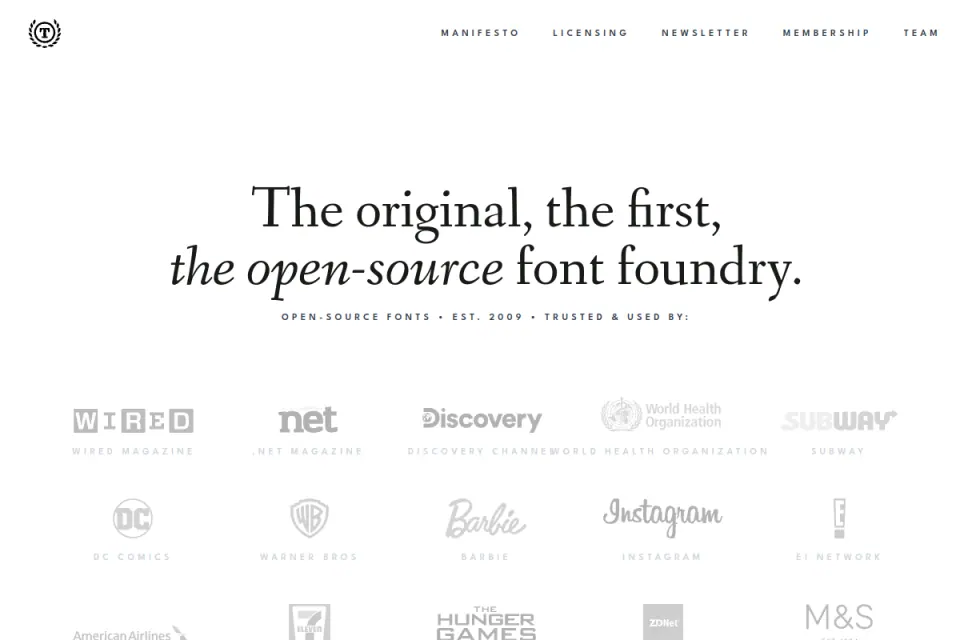
The League of Moveable Type manifesto describes an open-source font foundry, states that the catalogue uses the SIL Open Font License, and discusses personal and commercial use, modification and the obligation to keep derivative font software under compatible terms.
The smaller catalogue can be a strength when the team prefers to study fewer families more carefully. It also gives a useful model for connecting type distribution with education and creator attribution.
For the SaaS brief, the main decision is not whether the foundry is reputable. It is whether a particular family provides the weights, scripts and screen readability required by the product. Preserve the family's licence, author information and any reserved font names.
- Useful when: A compact open-source catalogue suits an editorial, identity or display direction.
- Check next: Family-specific styles, licence file, author credits and UI legibility.
- Do not assume: A distinctive display family will work for dense forms, tables or small labels.
5. Velvetyne — experimental character with a higher testing burden
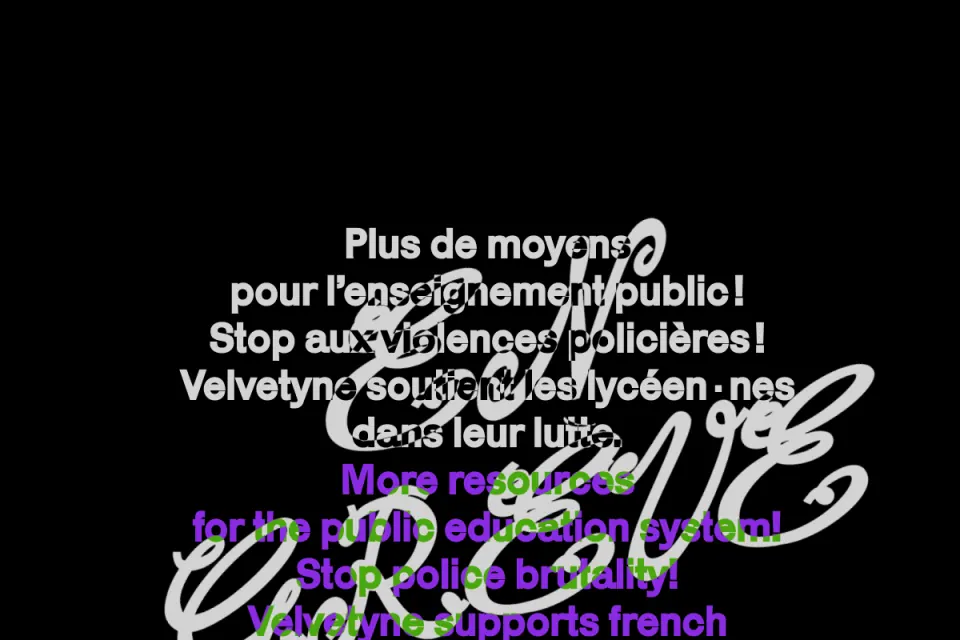
Velvetyne is useful for discovering expressive, unconventional type. The inspected preview is visually dense and politically expressive; that is part of the source context, not a neutral product-interface sample.
For a SaaS product, this source is more likely to contribute a campaign or display direction than a default body family. That is not a weakness. It simply means the shortlist should separate brand expression from the repeated reading tasks inside the product.
Open the selected family's page and licence file. Test confusing character pairs, numbers, punctuation, longer headings and fallback behaviour. If a face is intentionally irregular, the team should record where that character helps and where it begins to reduce comprehension.
- Useful when: The project needs a distinctive display voice or experimental reference.
- Check next: Family licence, language support, available styles and small-size legibility.
- Do not assume: “Libre” or “open” removes family-level conditions or usability tradeoffs.
6. Collletttivo — collaborative open-source type discovery
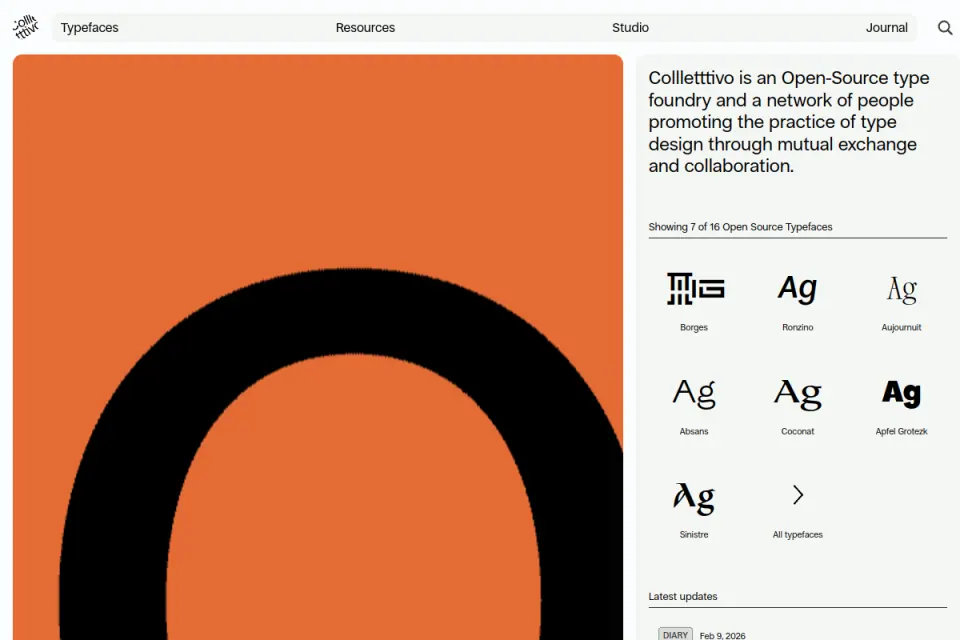
Collletttivo identifies itself as an open-source type foundry and network that promotes exchange and collaboration. Its inspected homepage preview shows multiple typeface names beside a large specimen, which makes the source useful for visual discovery and for learning about independent type practice.
The source description should not be converted into a blanket promise for every possible use. Read the individual family's included licence, preserve creator attribution and note any conditions around modification or redistribution.
For the SaaS exercise, use Collletttivo as a candidate source for a distinctive heading family. Then compare its coverage and weights with the body family selected elsewhere. A visually strong combination still fails if the hierarchy cannot cover the actual product content.
- Useful when: The team wants independent open-source references and distinctive headline options.
- Check next: Family files, licence, creator credit, scripts and usable weights.
- Do not assume: Catalogue-level open-source language replaces the family's licence record.
Fit and limitations
Use a licence-first shortlist instead of a moodboard-only choice
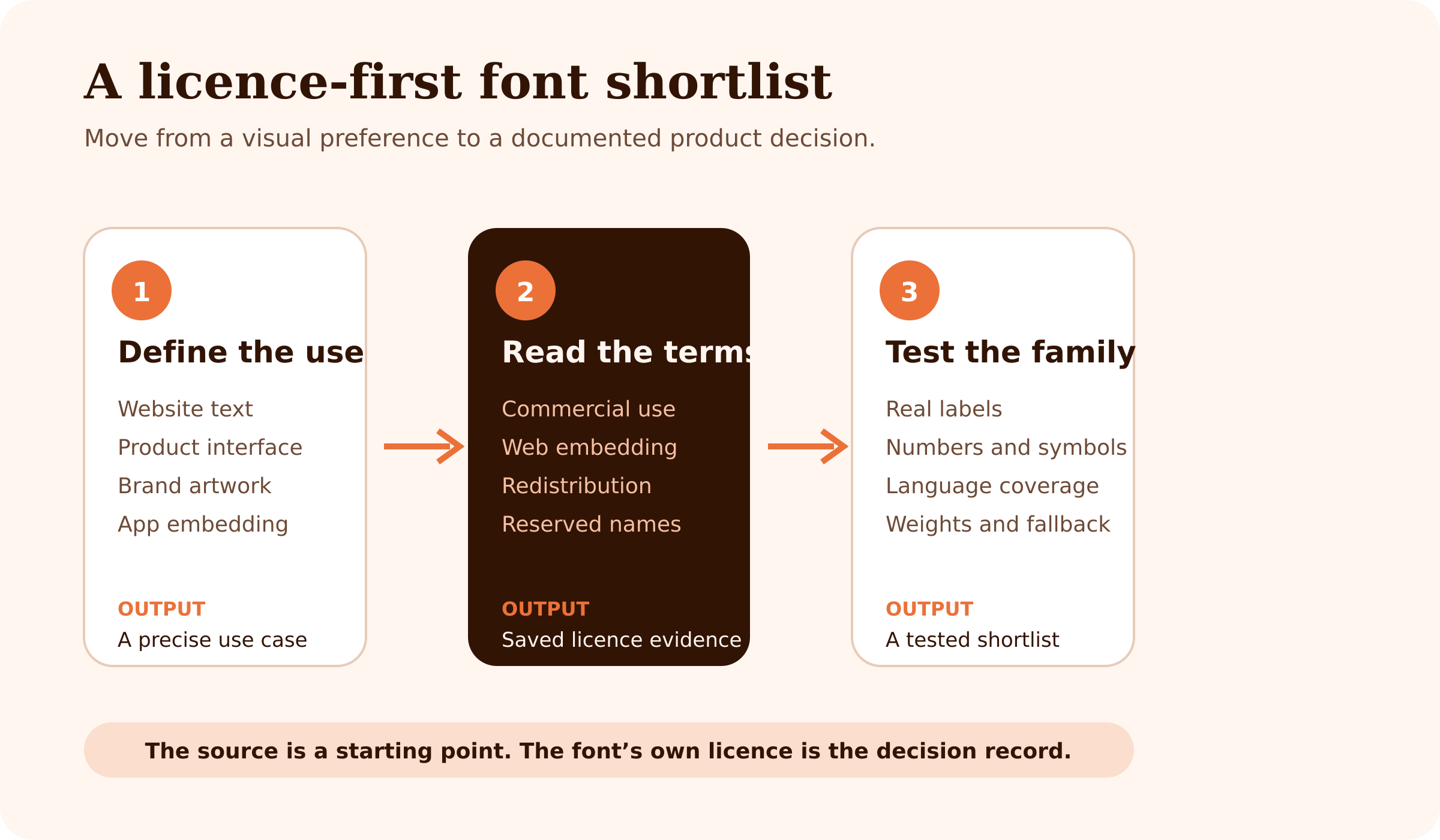
The worked method has three steps.
First, define the use. List the website, interface, artwork, PDF and app contexts that are actually in scope. Second, read the terms for the selected family and save the evidence. Third, test the family with the product's real labels, numbers, symbols, languages and fallback requirements.
The order matters. A team that tests only appearance may invest in a family before discovering an embedding restriction. A team that checks only the licence may choose a family that cannot support its content. The useful decision combines permission and performance.
Understand the limits of “free”
“Free” can describe price, access, a licence category or a limited promotional offer. It does not always describe every use.
- Desktop use often covers static graphics and documents created with the font.
- Web embedding covers delivering font files through a website, but the allowed method can vary.
- Application embedding may be treated separately from website use.
- Editable templates can expose font files or enable reuse in ways a static export does not.
- Redistribution concerns sharing the font software itself, not merely an image made with it.
- Modification can create naming, notice or share-alike obligations.
The safest editorial claim is narrow and attributable: describe what the source currently states, then point readers to the selected family licence. Do not turn one catalogue's policy into a universal rule.
Preview images have limits too
The six images in this guide are stored public website previews from the Inspire resource directory. They help readers understand the browsing context. They are not complete product tests, authenticated captures or proof that every family remains available. The live source and family terms should be checked at the time of selection.
How to choose
Work through a SaaS typography exercise
Assume a team is designing a customer-support product with a marketing website and a web application. The interface includes ticket IDs, dates, status labels, tables, long customer messages and occasional Hindi names. The marketing site needs an expressive heading style without weakening body readability.
Create a shortlist with two roles:
1. A body/UI family with clear numerals, punctuation, at least regular, medium, semibold and bold weights, and verified script coverage. 2. A heading family that adds character while preserving readable product and campaign titles.
For each candidate, test the same content: “Ticket #18472 · Payment failed · Reopened 02 Nov 2026,” a 60-character navigation label, a dense table row and a paragraph of customer text. Add the required non-Latin sample rather than assuming coverage from the family name.
Record the result in a small decision table:
| Question | Evidence to preserve |
|---|---|
| Is the intended commercial use allowed? | Family licence or official terms URL and saved file |
| Can the font be delivered on the website? | Web-embedding clause or approved provider route |
| Does it cover the required language and symbols? | Character-set evidence plus tested sample text |
| Are the necessary weights available? | File list or variable-axis information |
| Does it remain readable in product contexts? | Screenshots of actual labels, tables and paragraphs |
| Can another team member reproduce the choice? | Source URL, version/date and project notes |
Stop browsing when two or three candidates meet the brief. A larger moodboard does not automatically improve the decision.
If a designer wants structured practice with typography, variables and interface systems, Upslide Design School's free 14-day UI/UX course provides a practical learning path. The exercise above can be reused as a typography brief.
Frequently asked questions
Which websites offer free fonts?
Google Fonts, Fontshare, Font Squirrel, The League of Moveable Type, Velvetyne and Collletttivo are six useful starting points reviewed here. They differ in catalogue size, curation and licence presentation. The selected font family's own licence remains the final project record.
Does a free font download allow commercial use?
Not automatically. “Free download” can describe price without granting every commercial, embedding or redistribution right. Read the licence supplied with the specific family and confirm the intended use.
Can free fonts be embedded on a website?
Some can, but the allowed delivery method depends on the licence. Check whether self-hosting, a provider service or another route is permitted. Do not infer website embedding from desktop-use permission.
How should a founder choose fonts for a SaaS interface?
Start with the interface's reading tasks, languages, numerals, symbols and required weights. Test realistic labels, tables, errors and long text. Then preserve the family licence and implementation decision so the team can reproduce it.
Which font files and weights should a designer look for?
The answer depends on the product, but a practical UI shortlist often needs regular, medium, semibold and bold styles, plus italic when the content uses it. WOFF2 is common for web delivery, while source downloads may also include variable or static desktop formats. Keep only the files the approved implementation requires.
How can a team check language and character coverage?
Use the source's language or glyph information, then test real names, interface labels, numbers, currency, punctuation and required non-Latin scripts. A marketing specimen is not enough evidence for a multilingual product.
What licence evidence should be saved with a design project?
Save the family name, author, source URL, download date, licence name, licence file or terms page, version if available, and the approved uses. Record any attribution, reserved-name, modification or redistribution conditions.
Key takeaways
- Choose a font source after defining the product use and content requirements.
- Treat a directory as a discovery layer; save the selected family's licence.
- Separate commercial artwork, web embedding, app embedding and redistribution checks.
- Inspect scripts, symbols, weights and real interface text before adoption.
- Label public website previews accurately and revisit live source terms when implementing.
- Keep a short decision record so design, development and legal review can recover the evidence.
We help SaaS and enterprise teams turn visual decisions into usable product systems. If the typography choice is part of a larger interface redesign, explore Upslide's UX redesign services. For continued discovery, browse the Font resources in the Upslide Inspire Resource Box.