


When you see someone reach the last screen of a task, do you know whether they accomplished the goal, needed a revealing hint or were stopped by the test setup?
Usability testing investigates how relevant people use a product or service to pursue realistic goals. The value comes from the study's design and interpretation, rather than the presence of a recording or a completed-task label.
A useful study connects the question, participant, task, artifact and observed outcome. It also makes room for assistance, uncertainty and technical interruptions that would otherwise disappear inside a convenient success score.
This guide covers the complete method and three supporting software routes. An original study-plan and outcome-coding exercise uses invented invoices and traces; it does not report participant research, a vendor trial or a product benchmark.
Record what the person accomplished and what influenced it, rather than treating screen arrival as the whole result.
Design task
Choose a question that observation can answer
Start with a decision the team needs to make. “Do people like the redesign?” concerns reactions; “Can the intended role identify the record needing follow-up?” concerns using the design toward a goal.
Those questions may both matter, but they need different evidence. A preference response does not establish task completion. An observed completed task does not establish long-term adoption or satisfaction.
NN/g's usability-testing introduction describes the relationship between a participant, realistic tasks and facilitation or observation. It distinguishes qualitative investigation from quantitative measurement and moderated work from independent remote participation.
Choose the approach around the decision. A formative study may investigate where an interaction breaks down. A quantitative comparison needs a sufficiently specified measurement and sampling plan; attaching a percentage to a small convenience exercise does not create one.
Define the audience and artifact
Relevant experience matters more than a matching label. A person who approves invoices may know a different part of the workflow from someone who creates them, even when both work in finance.
Specify the experience required and the circumstances that could affect the task. Keep screening appropriate to that need, avoiding unnecessary personal details. Panel availability and employee willingness are recruitment routes rather than proof of participant fit.
Name the artifact and its limitations. A sketch, clickable prototype and working application expose different behavior. Record the version, starting state and permitted data so later observations can be interpreted against the material actually presented.
The published low-fidelity wireframe guide addresses an earlier structure decision. A wireframe can support a study when the question matches its fidelity; it cannot demonstrate production behavior it does not represent.
Define the outcome before the session
Describe what meeting the goal would mean. “Reached the detail page” is an event. “Identified the correct overdue invoice and customer” is a different criterion.
Keep several fields separate:
| Record | What it helps establish |
|---|---|
| Goal criterion | What the person needs to accomplish or explain |
| Starting state | What information, role and artifact are available |
| Observed action | What actually happened during the attempt |
| Assistance | Whether an intervention revealed relevant information |
| Technical condition | Whether the setup allowed the task to be attempted |
| Interpretation | What the material supports and what remains uncertain |
These fields do not prescribe one universal scoring system. They make the intended interpretation discussable before a dashboard or memorable clip shapes the conclusion.
Resource kit
Keep the study plan ahead of the platform
A compact plan should identify the question, audience, artifact, task goals, session approach, recording arrangement, analysis criteria and next decision. It should also identify who will moderate, observe and review the material.
The GOV.UK moderated-testing guidance connects research questions with participants, task design, a discussion guide and session preparation. The Digital.gov session model provides another reference for introductions, setup, tasks, follow-up and analysis.
Neither reference makes a script universally appropriate. Adapt it to the study, relevant access needs and the organization's requirements. Do not copy promises about recording access or retention unless the actual arrangement can honor them.
The following tools support different operations. Their public descriptions are reasons to investigate a route, not evidence that an account, study or recording was tested here.
Maze: inspect the task configuration and metric meaning
Maze's prototype-testing page describes prototype studies, mission paths, task metrics and reports. Its first-click route ends after a click and uses author-defined successful elements; that is narrower than demonstrating an entire workflow.

Credit: Maze. Actual public product-page context, not an authenticated study, prototype imported by Upslide or participant result.
Use that distinction when selecting the study structure. Verify the actual artifact, success definition and retained context rather than treating every reported completion as the same outcome. This guide does not test account entitlements, import fidelity, AI-generated plans or the provider's speed claims.
Lookback: plan observation and later review together
Lookback's feature page describes an observation room, private observer communication, recording and transcription, timestamped sharing and exports. These operations are relevant when a facilitator and observers need different roles during a session.

Credit: Lookback. Actual public feature-page context, not an Upslide research session or verified capture result.
Check what the intended participant can share and what reviewers can recover afterward. A documented clip or transcript does not remove the need to inspect the task context. AI assistance, device capture and access conditions require their own selected-route evaluation; no account operation or accessibility assessment was performed for this guide.
Lyssna: connect a task prompt with its follow-up
Lyssna's prototype-testing page describes Figma-based studies, task prompts, follow-up questions and task-level reporting. Those features can support a study that needs both an attempted interaction and a subsequent account of it.

Credit: Lyssna and its displayed creators. Actual public product-page context; ratings, examples and customer claims remain provider material.
Choose the task structure around the research question. Keep what the person did separate from what they later said, and verify the actual participation route and retained evidence. No panel-quality comparison, recruitment-speed result, free-plan entitlement or completed study is claimed here.
How the pieces work together
Write a goal-based task, then pilot the setup
A useful task provides a believable reason to act without giving away the intended route. Naming the navigation item, sort control and correct record can turn a test of discovery into an instruction-following exercise.
State the necessary context, including dates or role constraints that affect the answer. Avoid making the task harder by withholding information a person would ordinarily have. Likewise, avoid explaining the interface simply because the team already knows the preferred route.
A pilot should examine the actual starting state, wording, artifact behavior and capture. Ask whether the task is feasible and relevant. A successful technical pilot does not establish that the later study represents the audience or that the design is usable.
For an early artifact, the published free wireframe tools guide can help choose a creation route. The study still needs its own usable setup and an explicit statement of what that artifact cannot simulate.
Prepare participation and observation deliberately
Explain the session and the participant's choices before beginning. Address recording, access, retention and withdrawal through the actual approved process rather than treating a generic introduction as sufficient permission.
Arrange any needed communication or access support with the participant. An unfamiliar test setup can introduce difficulty unrelated to the design being investigated. Keep the accommodation and its effect on interpretation identifiable.
Digital.gov's guidance distinguishes the moderator from quiet observers and recommends non-leading questions. That division helps prevent a session from becoming a product explanation or a debate with the participant.
An observer can flag a point for later investigation without interrupting the attempt. Agree how that communication will happen and who makes the decision to intervene.
Observe the attempt and record interventions
The researcher needs enough context to understand what happened before, during and after a difficulty. A short clip of a final click can omit the earlier explanation or hint that made it possible.
A neutral follow-up and a directional cue are not automatically equivalent. Asking about an expectation may serve a different purpose from naming the control to select. Record the actual intervention and when it occurred instead of relying on a generic “helped” flag alone.
GOV.UK notes that occasional assistance can allow the session to continue and reveal more. That does not justify relabelling the subsequent completion as independent. State the research purpose and preserve what changed after the intervention.
If the prototype fails to load necessary data, investigate the setup. Do not automatically score the person as unable to perform the work. Conversely, avoid dismissing every difficulty as technical without examining the actual context.
Separate behavior, account and interpretation
Record observations before compressing them into findings. “Opened the newer invoice” describes an action. “Did not understand overdue” is an interpretation requiring more support.
A follow-up account can help explain an action while remaining different from observed behavior. Keep both available and preserve contradictory material. A confident explanation is not necessarily the only plausible one.
Upslide's research-methods guide addresses the broader choice of evidence. Here the task is interpreting a usability attempt without turning every hesitation, preference or technical incident into a design defect.
Turn findings into priorities and a retest
Group related observations while retaining their important differences. An issue blocking a required task can deserve different treatment from a cosmetic concern, but severity still depends on the task, context and available evidence.
Write the supported problem, its consequence, uncertainty and proposed next step. Keep the response distinguishable from the finding: observing a missed control does not prove that making it orange is the appropriate fix.
Retest the meaningful change using appropriate tasks and conditions. Record material differences between versions or study setups. A later result cannot be treated as a clean comparison if the artifact, instructions and assistance all changed without acknowledgment.
The Great Question method guide connects study goals, realistic tasks, observation and analysis. Its workflow is useful context; commercial outcome claims and automatic synthesis do not establish the result of a particular redesign.
Limitations and alternatives
A usability study answers a bounded question
Task observation can identify difficulties under the study's conditions. It does not automatically establish market demand, long-term adoption, business return or how often an issue occurs across the whole audience.
Choose participant numbers and measurement design from the question rather than a universal rule. This guide does not prescribe a fixed sample, session duration or target percentage. Quantitative claims require an appropriate study and denominator.
Technical checks and human research serve different purposes
A deterministic check can establish that a declared answer matches a dataset or that an artifact reaches a state. It does not establish that a person understood the interface or could perform the task independently.
Expert inspection, functional testing and accessibility evaluation can identify other problems. They can complement usability research without being relabelled representative-user task evidence.
This distinction matters in the original exercise below: its code examines invented records. Calling that execution a usability test would overstate what happened.
Software cannot repair a weak study automatically
A panel does not establish relevant experience. An automatic score does not establish that the task was fair. A generated summary does not establish that its interpretation matches the recording.
Use automation where it helps the work and review important conclusions against the retained material. Keep unresolved limitations visible rather than using a polished report as a substitute for them.
Worked example
Define the goal with an original dataset
Upslide authored a fictional invoice-workspace study plan, paired task cards, a three-invoice dataset and four synthetic outcome traces. No participant was recruited or observed, and no interactive prototype was implemented.
The declared date is 4 November 2026. The task is to identify the unpaid invoice that has been overdue longest and name its customer. The dataset contains:
| Invoice | Customer | Due date | Declared status |
|---|---|---|---|
| INV104 | Harbor Works | 10 October 2026 | Unpaid |
| INV214 | Cobalt Studio | 28 October 2026 | Unpaid |
| INV319 | Evergreen Labs | 12 November 2026 | Unpaid |
The executed rule reopens the actual CSV and derives INV104 / Harbor Works as the target. It selects the oldest due date among unpaid invoices already overdue on the declared date. This is a dataset calculation, not a participant outcome.
Compare instructions without claiming a wording test
The leading card tells the person to open Invoices, sort by due date and select INV104. It names both the route and answer.
The goal-based candidate gives the date and asks for the unpaid invoice overdue longest and its customer. It does not name a control, sorting operation or invoice ID.
These are authored contrasts for human review. The exercise does not run an automatic neutrality analysis, and no participant pilot establishes that the revised wording is understandable, unbiased or relevant.
Classify the invented traces against the declared criterion
Each trace records endpoint arrival separately from the answer, directional assistance and technical conditions.
| Invented case | Endpoint record | Declared interpretation |
|---|---|---|
| C1 | Details reached; correct invoice and customer; no directional cue | Independent criterion met under the declared flags |
| C2 | Details reached; correct answer after a directional cue | Criterion met with directional assistance |
| C3 | Necessary artifact data could not be opened | Not evaluable because of a technical block |
| C4 | Details reached, but answer identifies INV214 / Cobalt Studio | Criterion not met |
The actual CSV was written and reopened before classification. The technical case retains a null criterion result rather than being coded as a failed task. Endpoint arrival does not decide any case's goal classification.
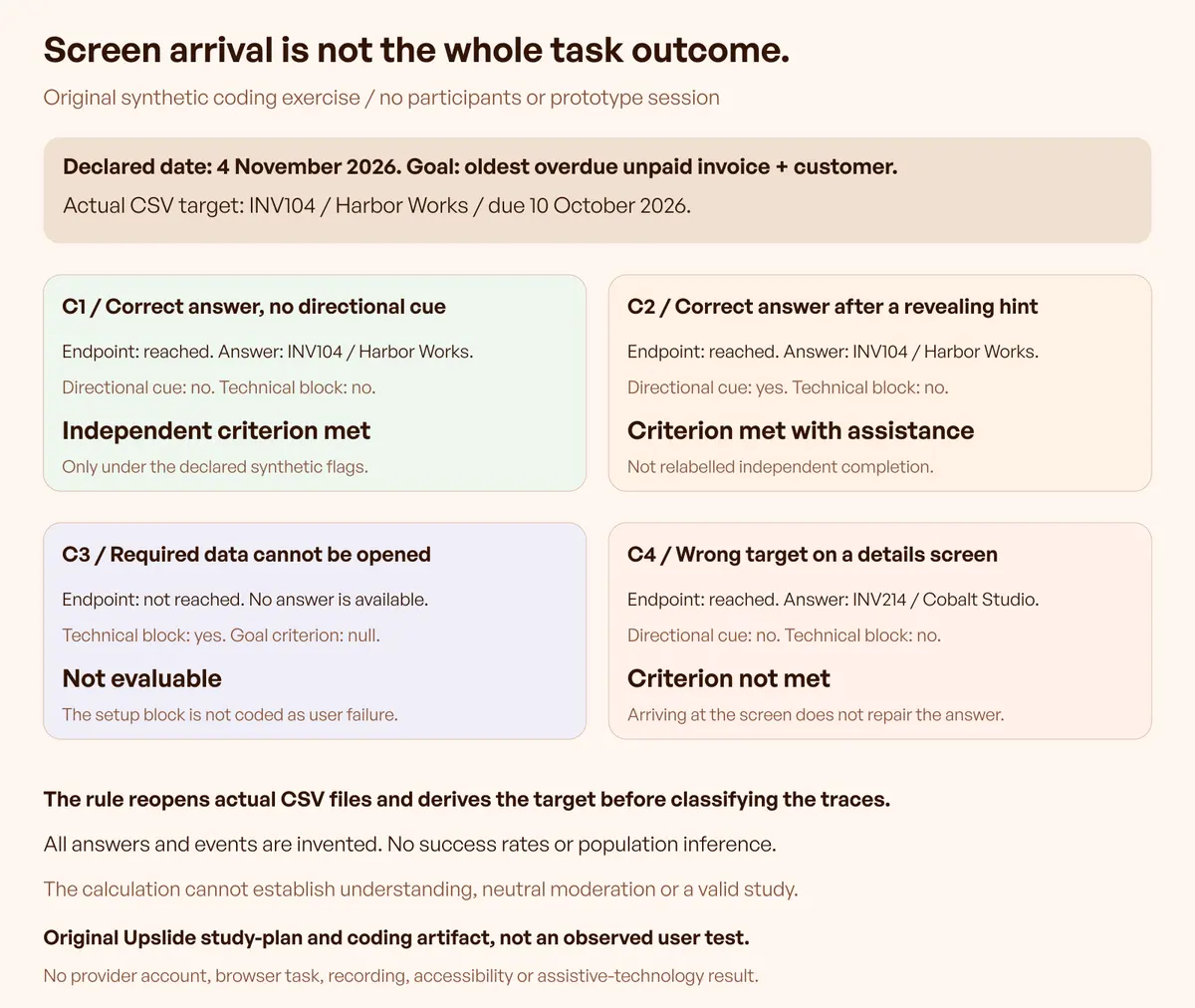
Original Upslide teaching artifact. All four traces are invented. No participant study, success rate, session recording, provider operation or measured improvement is represented.
Keep the calculation inside its actual boundary
The classifications follow the declared answers and flags. They do not observe understanding, judge the moderator's actual language or establish that the study plan is complete.
A real study would need the actual participant experience, session context and researcher judgment. The coding example illustrates why those distinctions deserve space in the plan before a team interprets a dashboard or report.
Use Resource Box to choose supporting tools once the study requirements are clear. Use Daily Inspire for credited visual references; an attractive interface capture cannot replace evidence from a relevant task attempt.
Frequently asked questions
What is usability testing?
It investigates how relevant people use a product or service to complete realistic tasks. Researchers observe the attempt and interpret the evidence against the study's question and conditions, rather than treating opinions or screen arrival as sufficient proof.
Is asking whether someone likes the design enough?
It supplies a reaction, not evidence that the person can complete a task. Preferences can matter, but keep them distinct from behavior and comprehension. Choose the activity around the decision being investigated.
How many participants are required?
That depends on the study's purpose, audience variation and intended claims. A qualitative investigation and a quantitative benchmark have different requirements. This guide does not apply a universal participant count or infer population performance from its invented cases.
Should a moderator ever help?
An intervention may allow useful investigation to continue, but its purpose and timing need recording. Preserve the distinction between independent completion and completion after a directional cue. Review the actual prompt rather than assuming every follow-up has the same effect.
Is a technical failure a failed user task?
Not automatically. If the required artifact cannot be accessed, the attempt may not be evaluable for the intended question. Investigate the setup and retain the limitation instead of turning it into a claim about the person.
Do automatic completion metrics establish understanding?
Only interpret a metric against its configured definition and supporting context. Arrival at a screen may be recorded correctly while the person identifies the wrong record or reaches it after a revealing hint.
Can a prototype establish production usability?
It can provide evidence about the represented interactions under the study conditions. Record missing behavior, data and access constraints. A prototype does not establish the performance of production functionality it does not implement.
What did the original exercise actually execute?
It wrote and reopened synthetic CSV files, derived a target from declared dates and classified four invented traces. It did not run a human study, implement a prototype, test providers, calculate success rates or perform accessibility evaluation.
Key takeaways
- Define the research question, relevant audience and actual artifact before choosing software.
- Use realistic goal-based tasks and pilot the setup without treating the pilot as product validation.
- Record goal outcomes, assistance and technical conditions separately from endpoint arrival.
- Preserve observations and uncertainty when turning material into findings.
- Prioritize a supported problem, evaluate the proposed response and retest the meaningful change.
We help teams connect research questions with clearer product decisions. If the study exposes a broader interaction problem, discuss the design work with Upslide.


